The Art of Vexillology: Curating Globdrop's Diverse Flag Scenarios
Flags are among the most powerful visual symbols in human history. A simple combination of colors and geometric shapes can represent the identity, values, and history of millions of people. The study of flags—known as vexillology (from the Latin vexillum, meaning banner)—is a fascinating intersection of design, political history, and cultural identity. For a geographer or cartographer, flags are the visual translation of a map.
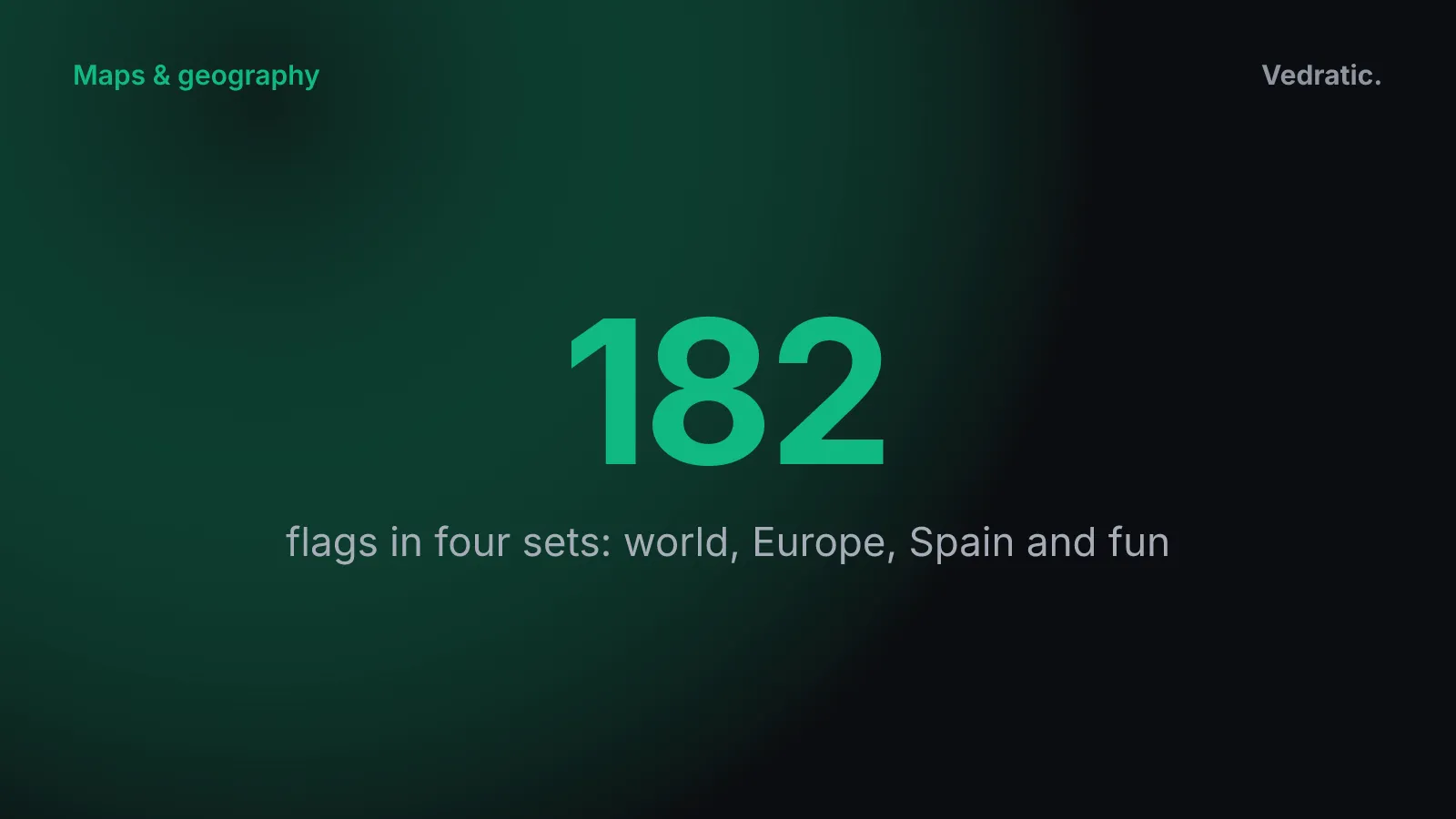
When we decided to integrate a Flag Mode into Globdrop, we didn’t want to just dump a list of every flag in the world and call it a day. The four scenarios hold 182 flags between them: 74 in World, 35 in Europe, 19 in Spain and 54 in Fun. We wanted to design a curated, educational experience that highlights the design details of different flag systems. In this article, we’ll go behind the scenes of how we curated our four flag scenarios and explore the vexillological details that make them so intriguing.
The Four Scenarios: Structuring the Catalog
To provide a structured progression system for players, we divided our collection into four distinct files loaded dynamically by the Globdrop game engine:
1. The World (world.json)
74 countries from every continent. From the widely recognized stripes of the United States and France to the complex, symbol-rich banners of nations like Bhutan (featuring the Thunder Dragon) or Sri Lanka (with its golden lion).
2. Europe (europe.json)
A focused continental region. European flags are dominated by tri-color layouts (horizontal and vertical stripes) and the Nordic Cross pattern. This scenario challenges players to distinguish between highly similar color palettes and proportions in a localized pool.
3. Spain's Autonomous Communities (spain.json)
A deep-dive into regional identity. Spain's regions boast rich heraldic histories. This scenario includes historical regional designs, such as the Senyera of Catalonia, whose red and gold bars also appear, with other elements, on the flags of Aragon, the Balearic Islands and the Valencian Community, the white-and-green stripes of Andalusia, and the emblem-rich banners of communities like Navarre and the Basque Country (the Ikurriña).
4. Special / Fun Flags (fun.json)
Flags that don't belong to a country: international organisations (the UN, the Red Cross, the Olympic Games), cities (Barcelona, Tokyo, Chicago), regions (Bavaria, Quebec, Brittany), historical flags (the Roman Empire's SPQR, the Cross of Burgundy, the Republic of Venice) and a few curiosities like the Jolly Roger and the Principality of Sealand.
Vexillological Trivia: Deceptively Similar Designs
Write mode, where you type the name instead of picking it from a list, is where near-identical flags cost you points. In vexillology, several flags appear virtually identical at a glance but have distinct differences in color shades or aspect ratios. Here are some of our favorite examples (Chad and Côte d’Ivoire aren’t in the game yet; the rest are):
Chad vs. Romania
These two flags both consist of vertical blue, yellow, and red stripes. The resemblance is close enough that, in 2004, Chad was reported to be asking the United Nations to look into it. The only difference lies in the shade of blue: Chad’s flag uses a slightly darker indigo, whereas Romania’s uses a brighter cobalt.
Monaco vs. Indonesia
Both flags feature a simple top horizontal red stripe and a bottom white stripe. However, Monaco’s flag has an aspect ratio of 4:5, making it almost square, while Indonesia’s flag uses a wider 2:3 ratio. (Additionally, Poland’s flag is the exact inverse: white on top, red on the bottom!)
Ireland vs. Côte d’Ivoire
At first glance, they look like the same flag flipped. Ireland’s flag runs green, white, orange (from left to right). Côte d’Ivoire’s flag runs orange, white, green. However, they also differ in proportions—Ireland uses a longer 1:2 ratio, whereas Côte d’Ivoire uses a standard 2:3 ratio.
Curating the Difficulty Levels
To keep the game fun and prevent beginners from getting discouraged by obscure designs, we assigned every flag in the registry an easy, medium, or hard difficulty filter:
- Easy: Widely known national flags (e.g., Canada, Japan, Brazil).
- Medium: Less common flags, or regional flags with recognizable patterns (e.g., Jamaica, Kenya, Aragon).
- Hard: Small territories, historical flags and regional flags with complex heraldry (e.g., Bhutan, the Isle of Man, Castile and León).
The same flag can have a different difficulty in each scenario: Sweden is medium in World but easy in Europe.
How the flag scenarios play, and how they are scored, is in Introducing Flag Mode; the counts of every set are on the Globdrop page, and tips for the look-alikes in the strategy guide.