Household or My Share? Measuring Net Worth With Shared Accounts
Here is a question most personal finance apps answer wrongly without ever telling you: if you share a joint account, a flat and a mortgage with your partner, what is your net worth?
The typical app adds up every balance it can see. Your personal account, the joint account in full, the full value of the flat, the full mortgage. The result is a number that describes your household and presents itself as describing you. It isn’t a small error — with property involved, it can be off by tens of thousands of euros.
A Worked Example
Take a simple, invented situation with round numbers:
- A personal current account with €8,000, 100% yours.
- A joint account with €16,000, shared 50/50.
- A flat valued at €280,000, owned 50/50.
- A mortgage on that flat with €180,000 outstanding, also 50/50.
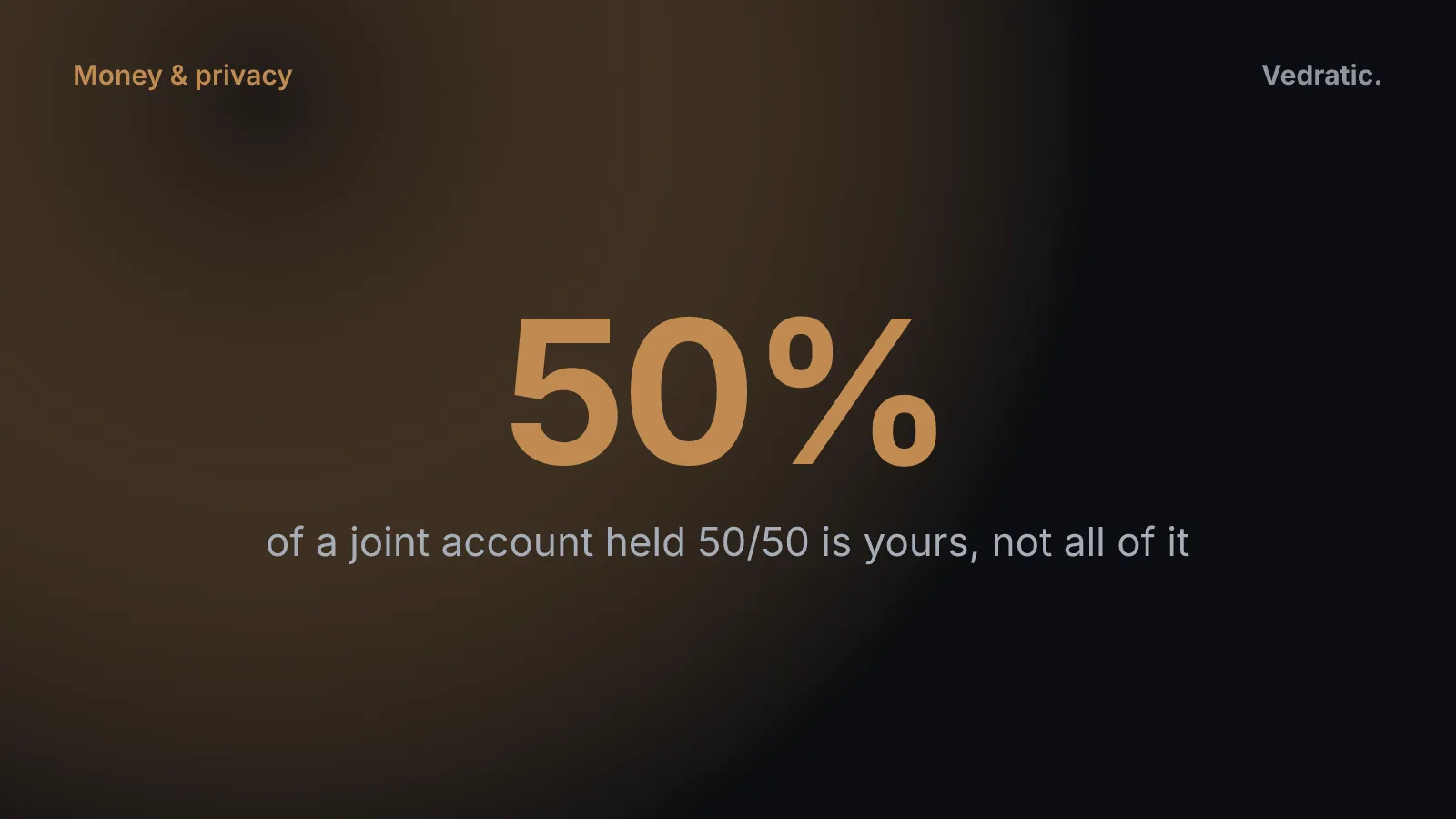
Summed naively, that’s €8,000 + €16,000 + €280,000 − €180,000 = €124,000. That’s a true figure — for the household. Your share is €8,000 + €8,000 + €140,000 − €90,000 = €66,000. Both numbers are correct. Presenting the first as the second is not.
Both questions are legitimate
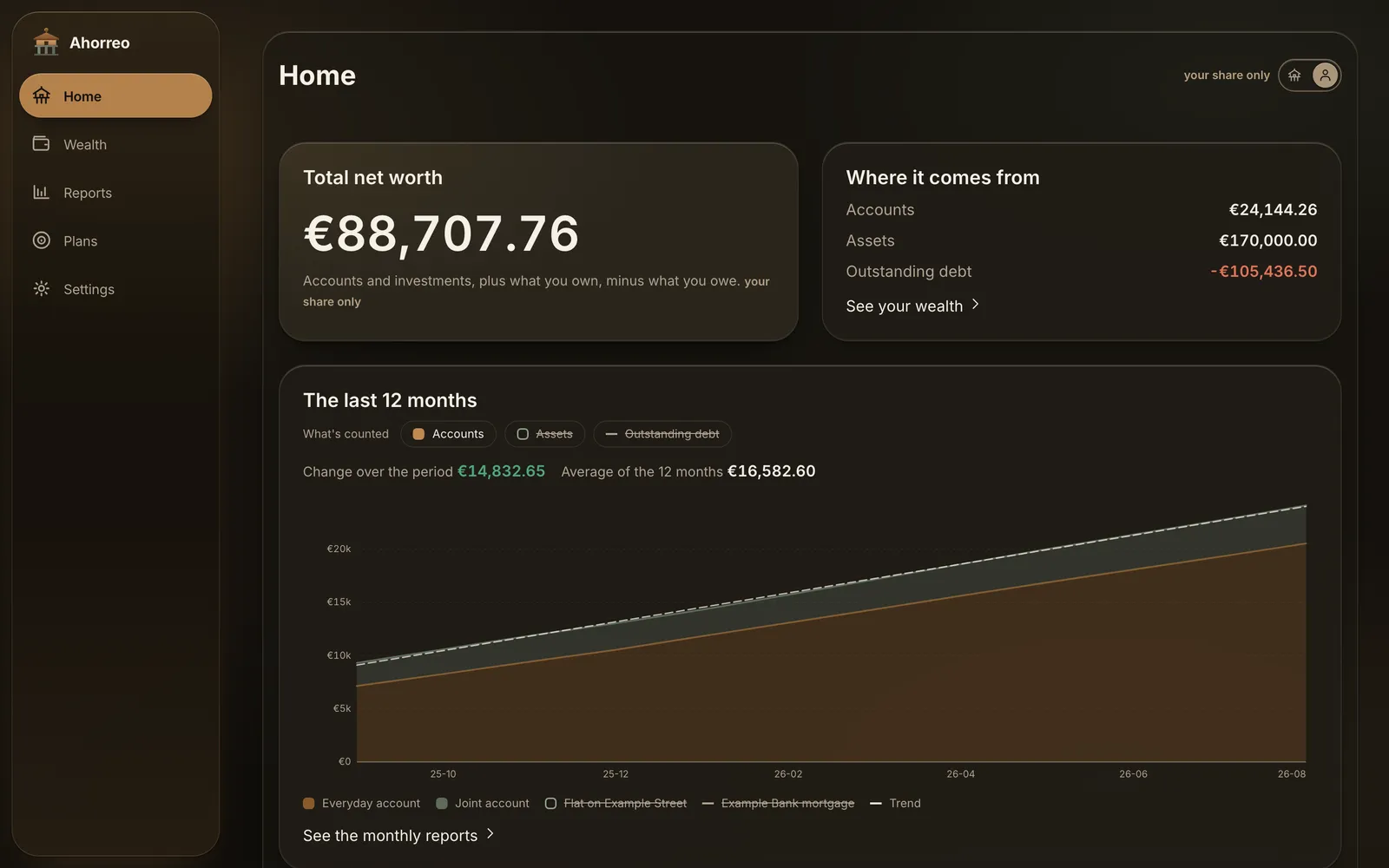
"What does our household own?" and "what do I own?" are both reasonable things to ask. The problem isn't picking one; it's showing a number without saying which question it answers. That's why Ahorreo has a single, always-visible switch between household and my share, and every screen states which one it's on.
Ownership as a Percentage, Not a Login
One way to handle shared finances is to give both people an account in the app and let them see the same data. That requires a server, user accounts, permissions and synchronisation — everything Ahorreo is designed not to have.
We took a different approach: ownership is a number. Each account, property and loan carries a percentage that says how much of it is yours. That number scales the calculations, and that’s all it does. It doesn’t grant anyone access, and Ahorreo stores nothing about the other person — you know who you share the account with; the app only needs to know your part.
Spending Is Subtler Than Balances
Balances are easy: multiply by your share. Spending from a joint account is where it gets interesting, because there are three different questions hiding behind “how much did I spend?”:
- What does this household cost? Every euro that left the joint account, in full.
- What does it cost me? Each expense scaled by my share.
- What do I put in? Only my contributions to the shared pot count as my spending; what the pot pays afterwards doesn’t count twice.
Which one is right depends on how you actually use that account, not on the app. So in Ahorreo it’s a per-account setting. A joint account that you and your partner both pay into and spend from like a common pot can be read one way; a shared account where one salary lands and both of you spend can be read another. For a “pot” account, Ahorreo also shows who contributed how much, what was paid from where, and how the split stands.
The payslip in the joint account
There’s a classic trap here. If your salary is paid into a joint account and that account is read at 50%, your income appears halved. That’s why exceptions exist per transaction and per category: the salary can stay 100% yours even though it lands in a shared account.
Mortgages: Only the Interest Is an Expense
Shared property brings one more distortion that’s worth fixing at the same time. A monthly mortgage payment of, say, €800 is not €800 of spending. Part of it is interest — a real cost — and the rest is principal, which reduces your debt and increases the share of the home you own outright. Money that simply changed place.
Ahorreo computes the amortization schedule for each loan, pairs each payment in your bank statement with its row in the schedule, and splits it into principal and interest. Only the interest shows up as an expense — the same idea behind booking date vs. accrual period: reports should describe what happened to your money, not how the bank moved it. Then the ownership percentage applies on top: half the mortgage, half the interest, half the principal.
If you want to see that split for a mortgage of your own, without importing anything, the mortgage calculator shows the payment, the interest and the principal year by year, and your share of each.
History Shouldn’t Be Rewritten
One last detail matters more than it seems. Ownership changes: you buy out a share, you open a joint account with a new partner, you sell. When you change a percentage in Ahorreo, the change is recorded with the date it takes effect rather than silently recalculating the past. Your net worth last year was what it was, with the shares you had last year.
The principle behind all of this is simple, and it’s one we try to apply everywhere: no figure without its base. A number that doesn’t say what it’s measuring is a number someone will misread — and in personal finance, that someone is usually you.
Ahorreo shows you your own numbers; it doesn’t give financial or legal advice about how to share assets or split costs.
This article explains how our software works and the maths behind it. It is not financial, tax or legal advice: for decisions about your own money, check with a qualified professional.