Why Visual Planning is Essential for Cross-Functional Teams
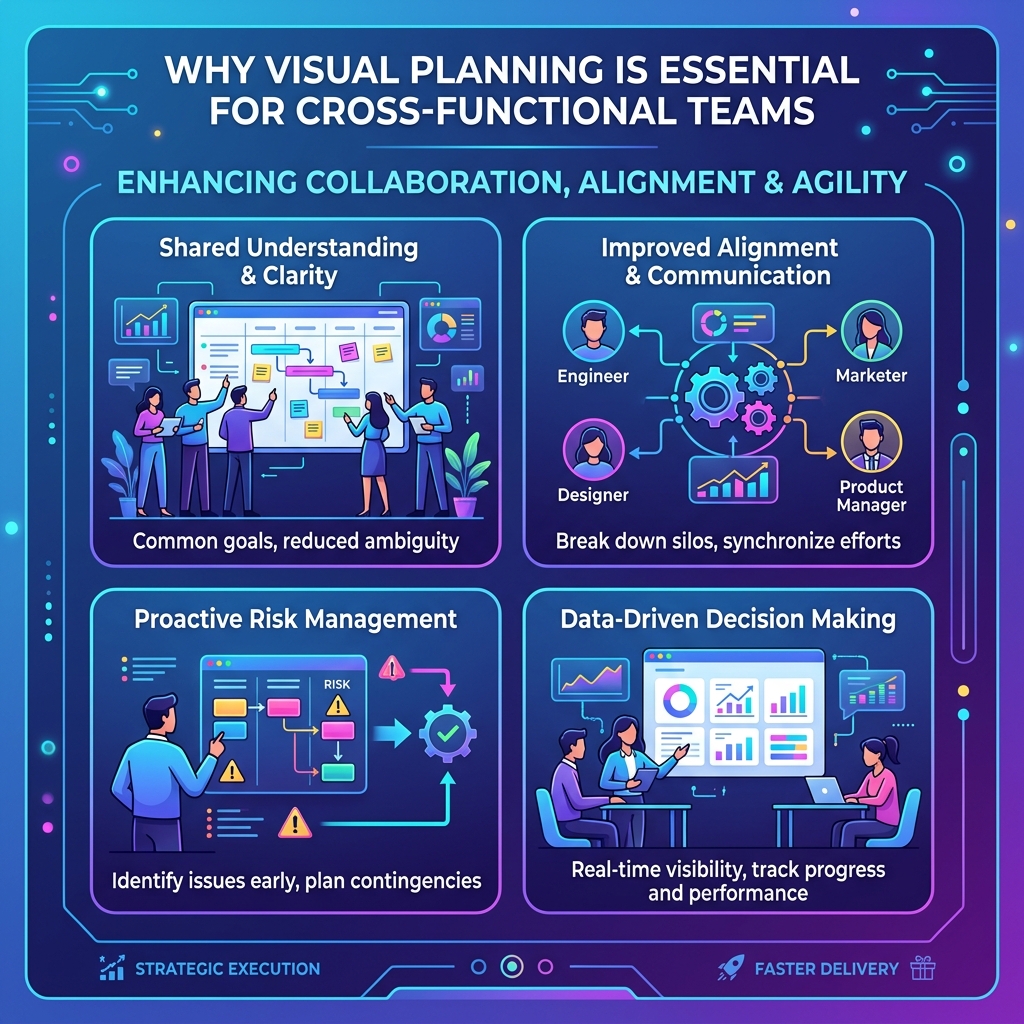
In modern product development, the siloed department is a relic of the past. Today’s most effective teams are cross-functional, combining engineers, designers, marketers, and data analysts into a single unit focused on delivering a specific outcome. While this structure is excellent for innovation and speed, it introduces a massive communication challenge: these professionals speak entirely different professional languages.
An engineer might measure progress in story points and pull requests. A marketer measures it in copy drafts and campaign launch dates. A designer measures it in wireframes and user testing cycles. When you put all these people in a room and ask them for a status update based on a flat spreadsheet or a text-based task list, alignment is almost impossible. This is where visual planning becomes not just a nice-to-have, but a vital necessity.
The Translation Problem
Imagine a scenario where the marketing team is waiting to launch an ad campaign for a new feature. They look at the engineering team's Jira board and see 15 tickets in the "In Progress" column. Does that mean the feature is launching tomorrow or next month? To the marketer, those tickets are gibberish. They lack the technical context to understand the scope of work remaining.
Conversely, the engineering team looks at a marketing spreadsheet with a hard launch date of the 15th. They don't realize that marketing needs 3 days prior to that date to finalize assets based on the actual UI, and legal needs 2 days to review the copy. The dependencies are hidden in the text.
The Visual Lingua Franca
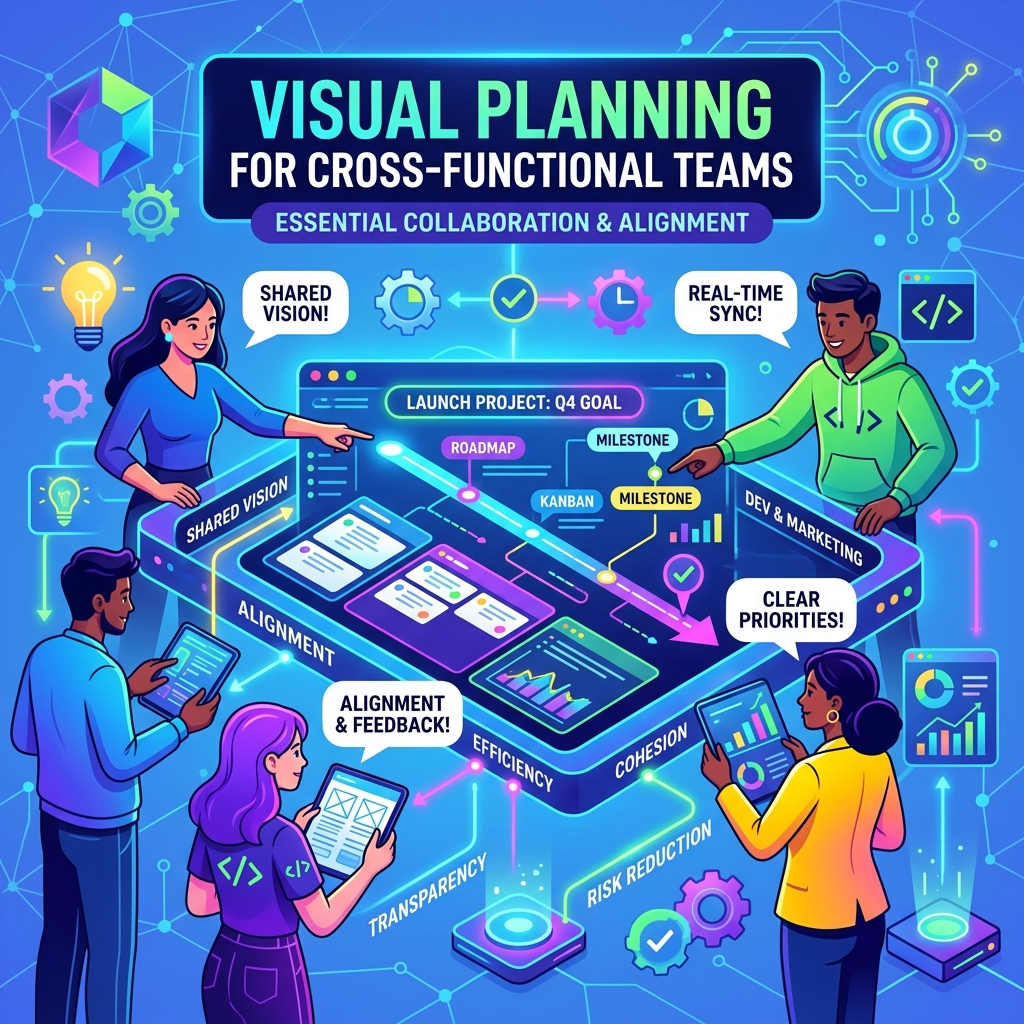
Visual planning tools, particularly timeline-based visualizations like Gantt charts, act as a universal translator. Why? Because while people may not understand each other's technical jargon, everyone understands time and space.
When a cross-functional team looks at a visual project map, several things happen instantly:
- Scope is spatial: A long bar means a big task. A short bar means a quick task. You don't need to understand what "refactoring the auth state" means to see that it’s going to take up half the sprint.
- Dependencies are explicit: An arrow pointing from the "UI Design" bar to the "Frontend Implementation" bar makes the relationship undeniable. The engineer can visually see they are blocked, and the designer can visually see who is waiting on them.
- Parallelism is obvious: Stacking bars vertically shows what is happening simultaneously. Marketing can see exactly what development is building while they draft the press release.
Reducing Meeting Overhead
Without visual planning, teams attempt to bridge the communication gap with meetings. "Syncs," "standups," and "alignment calls" eat up hours of the week as people try to verbally construct the shape of the project for each other.
A well-maintained visual plan replaces the majority of these status updates. When the visual map is the single source of truth, meetings stop being about what is happening and start being about why it is happening. Instead of spending 15 minutes establishing that Task B is delayed, the team can look at the chart, instantly see the bottleneck, and spend that 15 minutes brainstorming how to unblock it.
Building Empathy Across Disciplines
Perhaps the most underrated benefit of visual planning is that it builds inter-departmental empathy. In text-based lists, other people's tasks just look like unchecked boxes. It’s easy to feel frustrated when an unchecked box is blocking your work.
When those tasks are visualized on a timeline, the workload becomes tangible. When a developer sees that the QA engineer has a massive, two-week bar of testing immediately following code freeze, they gain an appreciation for the weight of that responsibility. When sales sees the interlocking dependencies required just to ship a single feature, they understand why the product team can't just "squeeze in one more thing."
Conclusion
Cross-functional teams are powerful because they bring diverse perspectives to a problem. But that diversity of perspective is useless if the team cannot see the same big picture. Text lists fragment the project into discipline-specific silos. Visual planning unifies the project into a single, understandable landscape. If you want your team to pull in the same direction, you have to show them the map.