The True Cost of Context Switching in Project Management
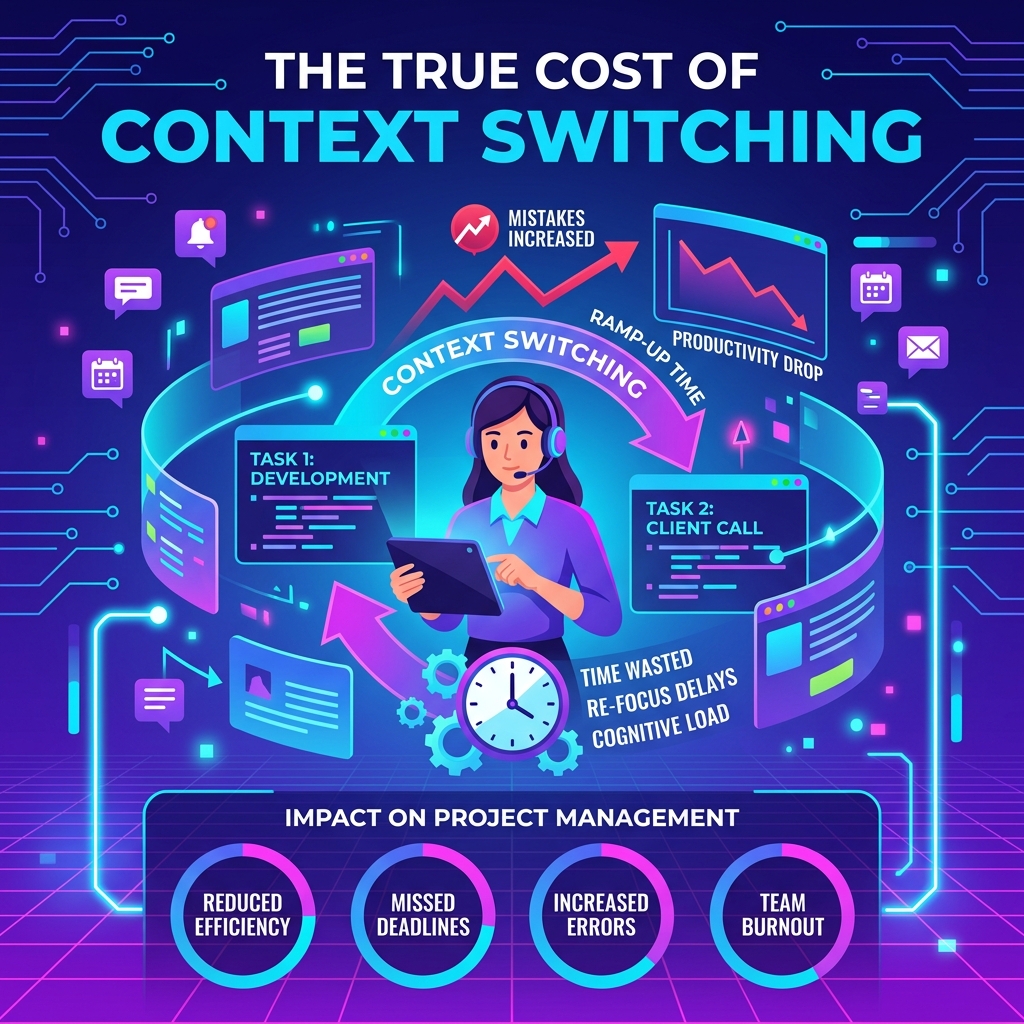
You sit down at your desk, open your code editor, and finally dive into that complex backend refactor you've been putting off. You load the mental model of the database architecture into your working memory. You find the exact line of code where the logic breaks. Your fingers hit the keyboard... and then a Slack notification pops up.
"Hey, quick question about the Q3 marketing assets—did we ever get client approval on the blue variant?"
You click over to Slack, search your memory for the marketing conversation, answer the question, and click back to your code. It only took 30 seconds. But when you look at the code, it looks like a foreign language. The mental model has collapsed. It will take you another 15 minutes just to get back to where you were.
This is context switching, and it is the silent killer of modern knowledge work.
The Neurological Tax of Multitasking
Despite what job descriptions claim, humans cannot multitask. The human brain is physically incapable of processing two complex cognitive tasks simultaneously. When we "multitask," what we are actually doing is rapidly switching our attention between tasks.
Neurologically, this is an expensive operation. Every time you switch contexts, your prefrontal cortex has to perform a "goal shifting" and "rule activation" sequence. It has to dump the rules, variables, and state of the previous task from working memory and load the rules, variables, and state of the new task. Psychologists call the time and energy lost during this transition the switching cost.
The Mathematics of Lost Time
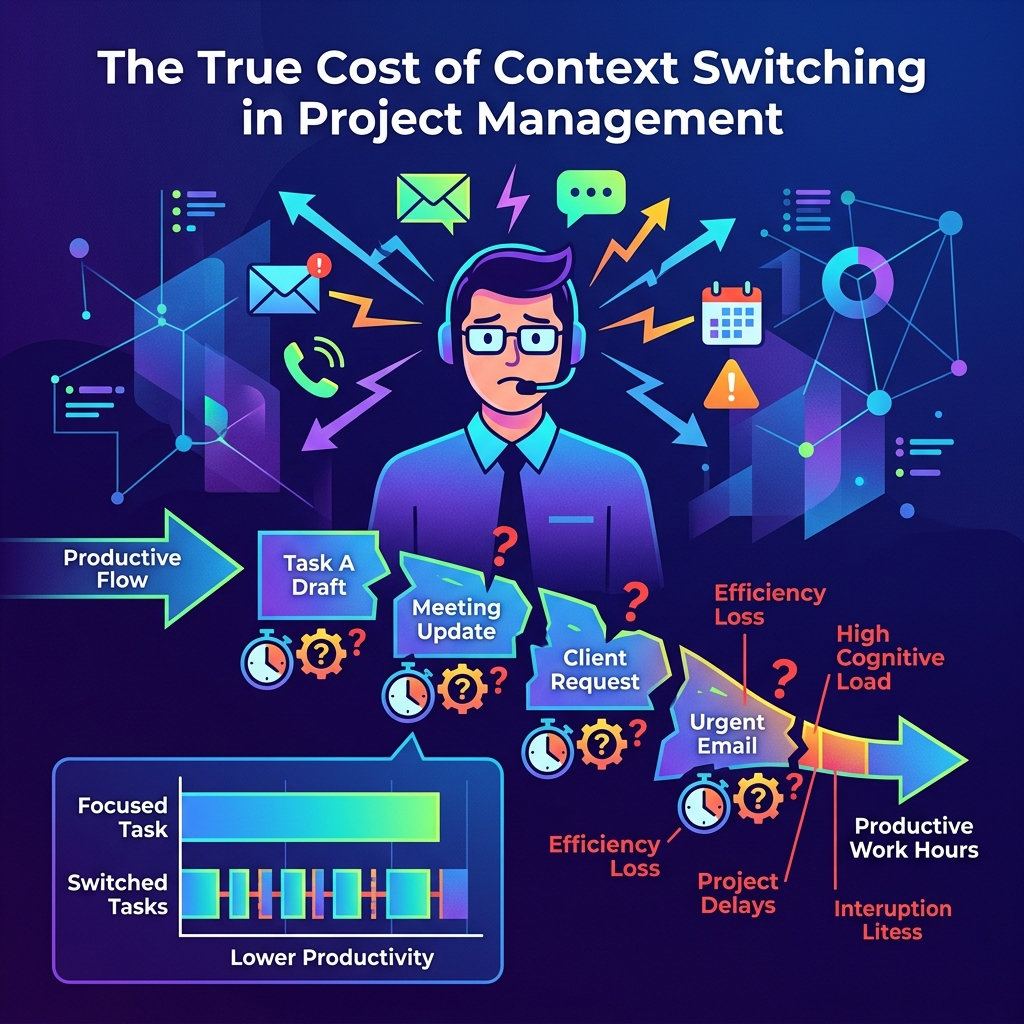
Research by psychologist Gerald Weinberg quantified this cost in his book Quality Software Management. Weinberg found that adding simultaneous projects drastically reduces the time actually spent on productive work:
- 1 Project: 100% of time spent on the project.
- 2 Projects: 40% on Project A, 40% on Project B, 20% lost to context switching.
- 3 Projects: 20% on each project, 40% lost to context switching.
- 5 Projects: 5% on each project, 75% lost to context switching.
If you have an engineer assigned to four different active projects, you are not getting 25% of their time on each. You are paying them for a full week, but they are only doing productive work for a few hours. The rest of their week is spent simply trying to figure out what they are supposed to be doing.
How Bad Project Management Drives Context Switching
Context switching isn't just a personal failing; it is usually a symptom of poor project management. It happens when:
- Dependencies are hidden: When a worker finishes a task but realizes the next task is blocked, they are forced to pick up an unrelated task from a different project to "stay busy."
- Everything is "High Priority": When management fails to aggressively prioritize work, employees try to inch everything forward simultaneously, resulting in nothing getting finished.
- Asynchronous communication is lacking: Teams rely on instant messaging and expect immediate replies, turning everyone's workday into a series of reactive interruptions.
The Visual Defense Against Context Switching
Good project planning is the strongest defense against context switching. A visual timeline (like a Gantt chart) allows managers to see exactly when an employee is being stretched across too many parallel tracks.
By mapping out projects visually, you can implement Resource Leveling. Instead of having a designer work 2 hours a day on 4 different projects for a month, the visual plan allows you to sequence the work: Project A gets 100% of their time for Week 1, Project B gets 100% of their time for Week 2, and so on. The total hours billed are the same, but the output will be significantly higher in quality and delivered much faster because the switching cost has been eliminated.
Conclusion
We often treat human attention as an infinite resource that can be divided endlessly without consequence. It isn't. Attention is a fragile, easily exhausted battery. As project managers and team leaders, our job is not to ensure that everyone is "busy" 100% of the time. Our job is to protect our team's ability to focus deeply on one thing at a time. Minimize the switching, and you will maximize the work.