The Hidden Risks of Over-Allocating Your Best Developers
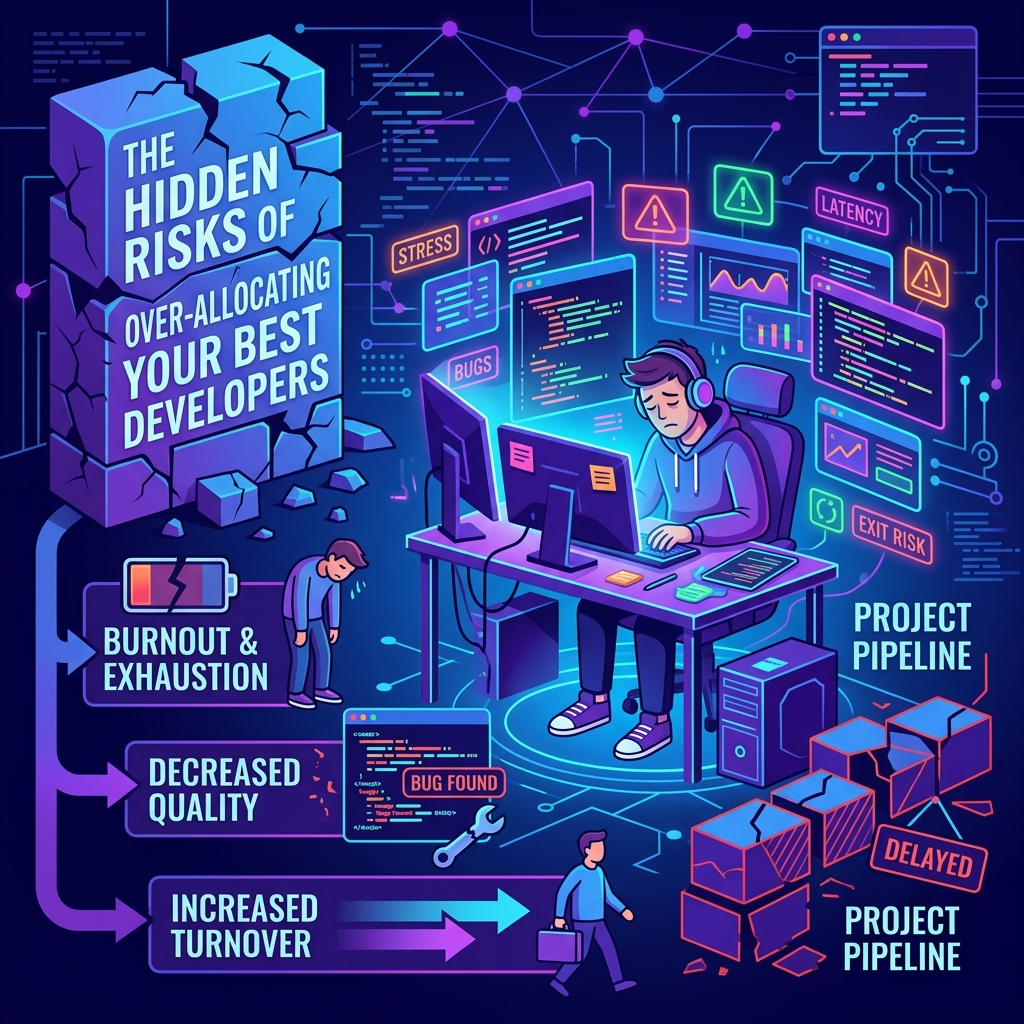
Every software team has one. The "10x engineer." The rockstar. The person who possesses deep institutional knowledge, solves complex architecture problems in their sleep, and debugs legacy code with frightening speed. Let's call her Sarah.
When a project manager is planning a high-stakes release, the natural instinct is to assign Sarah to every critical task. If the payment gateway integration is complex, give it to Sarah. If the database migration is risky, give it to Sarah. If the Junior devs are stuck, have Sarah review their code. It feels like the safest way to guarantee success.
In reality, this is the fastest way to doom your project. Over-allocating your best talent creates a single point of failure, guarantees burnout, and fundamentally breaks project timelines.
The Mathematics of a Bottleneck
To understand why this happens, we must look at the Theory of Constraints. In any system, the throughput of the entire system is limited by its tightest bottleneck. When you assign your top developer to multiple critical path items across parallel tracks, they become the bottleneck.
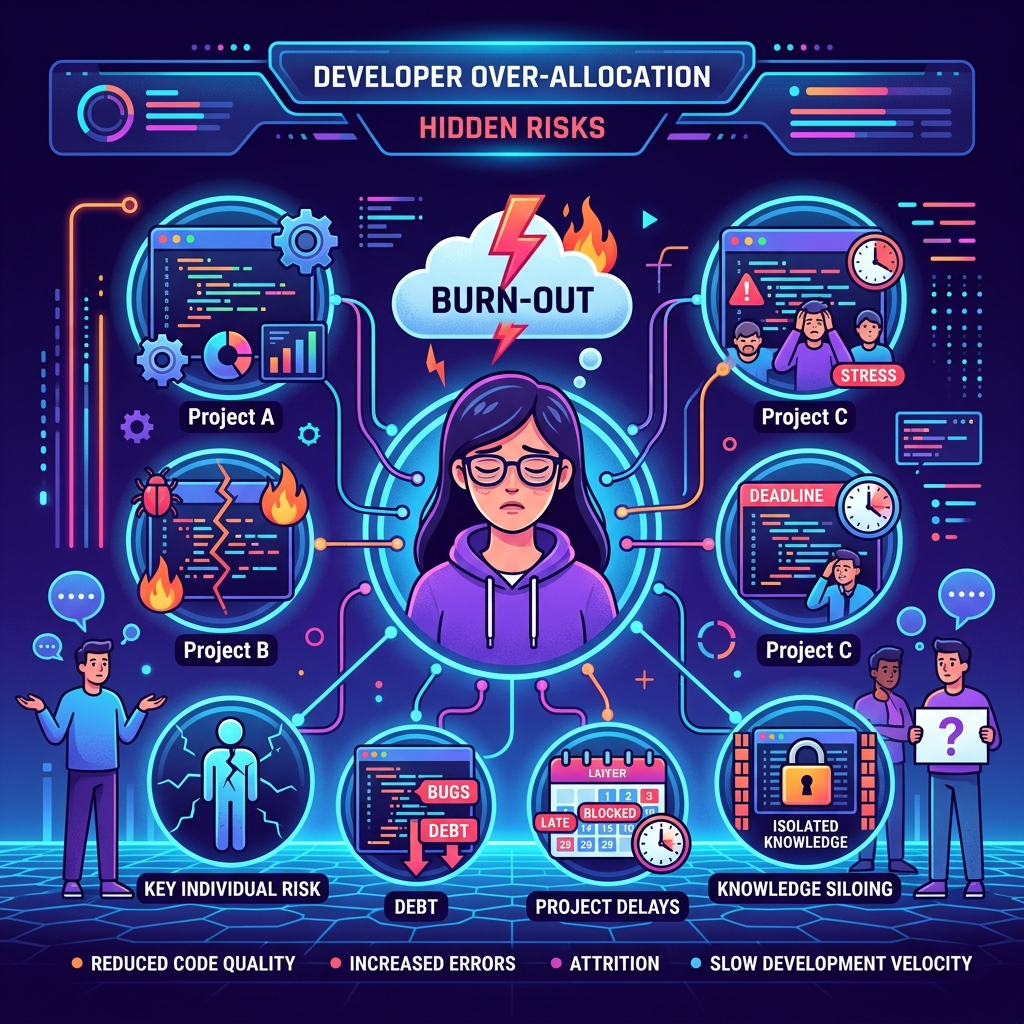
Let's look at the math. Sarah is assigned to Task A (3 days), Task B (4 days), and Task C (2 days). In a flat task list, this looks fine. But if Task A and Task B must happen simultaneously according to the project timeline, you have a physical impossibility. A single human being only has 8 hours in a workday.
Because Sarah is over-allocated, she has to split her attention (incurring massive context-switching penalties). Task A and Task B will both run late. Because she is running late on those, she won't start Task C on time. Every other developer downstream who is waiting on Tasks A, B, and C is now blocked, sitting idle while the company pays their salary.
The "Bus Factor" and Institutional Fragility
Beyond timeline delays, over-allocating your star developer creates immense organizational fragility. The "Bus Factor" is a morbid but useful metric: how many team members would have to be hit by a bus for the project to completely stall?
If Sarah is the only one who understands the payment architecture, the CI/CD pipeline, and the database schema because you assigned all those tasks to her, your Bus Factor is 1. If Sarah gets sick, takes a vacation, or burns out and quits, the project dies instantly. By refusing to allocate critical tasks to junior or mid-level developers, you are actively preventing them from learning the codebase, ensuring that Sarah will always be the bottleneck.
Resource Leveling: The Visual Solution
The cure for over-allocation is Resource Leveling. This is a project management technique that resolves overallocations by delaying tasks or reassigning them until every team member is assigned a realistic workload (usually capped at 80% capacity to allow for buffer and administrative overhead).
You cannot effectively level resources in your head or in a spreadsheet. It requires a visual timeline.
When you use a tool like Vedratic Project Manager, you assign a resource to a task bar. The software calculates the total allocation for that person on any given day. If Sarah is assigned to two concurrent tasks that demand 150% of her available time, the timeline lights up with a warning.
Seeing this visual conflict forces the project manager to make hard, necessary decisions before the project starts:
- Reassign: Give the payment integration to a mid-level developer. It might take them 5 days instead of Sarah's 3 days, but because they can work in parallel, the overall project finishes sooner.
- Sequence: Accept that Sarah is the only one who can do the work, and physically move Task B to start after Task A is finished, explicitly pushing the final project deadline back to reflect reality.
Conclusion
Your best developers are incredible assets, but they are still bound by the laws of space and time. A project manager's job is not just to organize tasks, but to protect the humans executing those tasks. By visualizing resource allocation and refusing to schedule 120% workloads, you prevent bottlenecks, eliminate the single point of failure, and create a sustainable environment where your top talent actually wants to stay.