Understanding the Iron Triangle of Project Management
Every project manager has heard some variation of this client request: "We need an app that does everything our competitor does, we need it launched by next month, and our budget is $5,000."
The standard, slightly cynical engineering response to this is: "Good, Fast, or Cheap. Pick two." This old adage is not just a joke; it is a colloquial summary of the most fundamental law of project management: The Iron Triangle.
The Three Constraints
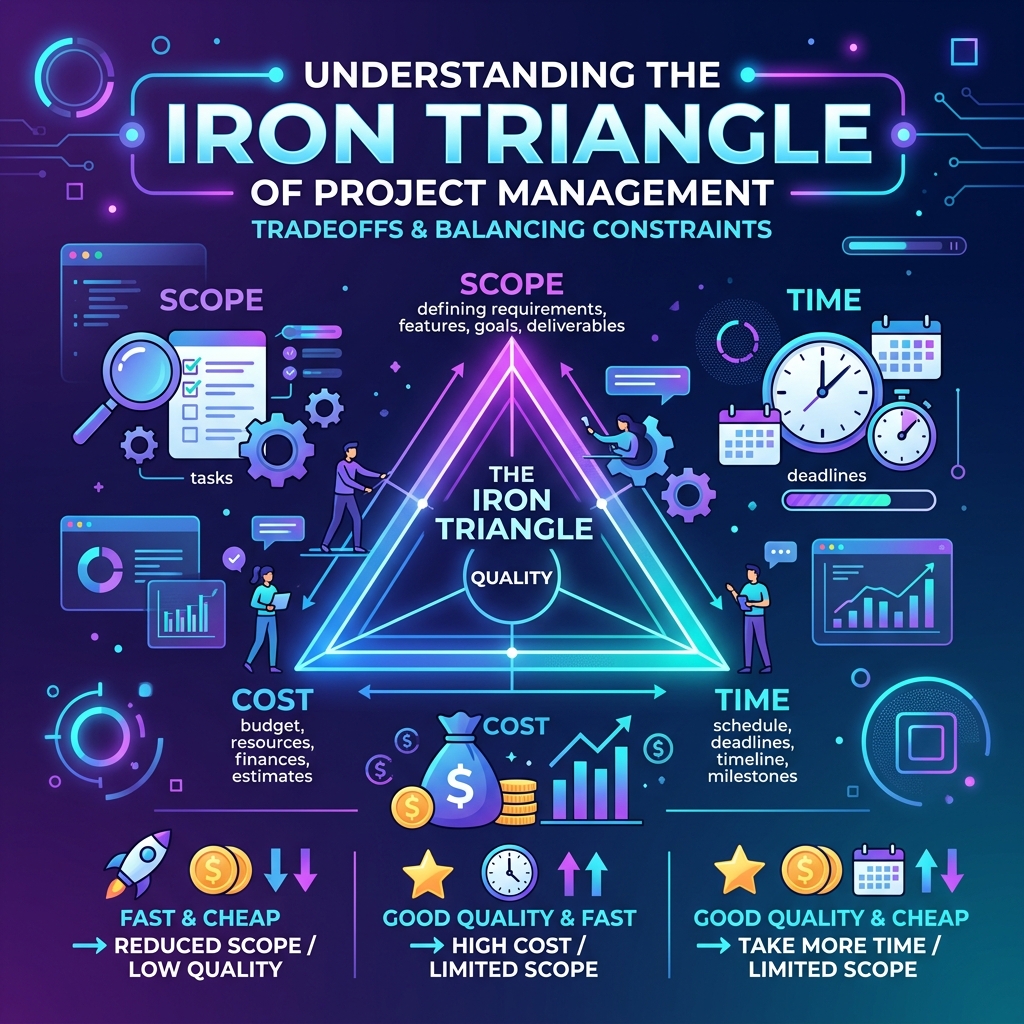
The Iron Triangle (also known as the Project Management Triangle) posits that the quality of a project is constrained by three interconnected variables:
- Scope (Good/Features): What exactly are we building? How many features does it have? How complex is the functionality?
- Time (Fast/Schedule): When does the project need to be delivered? What are the hard deadlines?
- Cost (Cheap/Resources): What is the budget? How many people can we hire? What tools can we buy?
The "iron" part of the triangle refers to the fact that you cannot alter one side without proportionately altering the other two. If you change the scope, you must either increase the time or increase the cost. If you cut the budget, you must either extend the timeline or reduce the scope.
The Quality Paradox
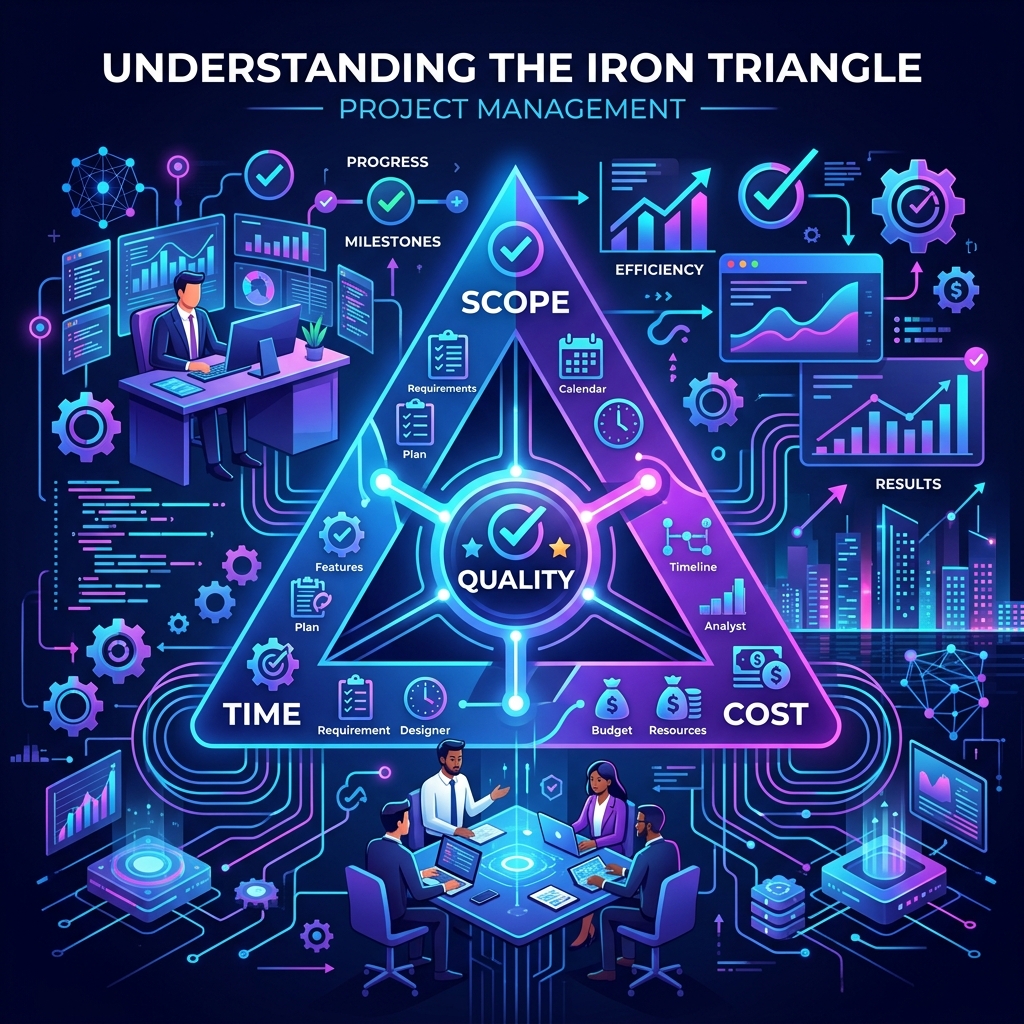
Often, Quality is placed in the center of the triangle. If a client attempts to force all three constraints simultaneously—demanding a massive scope, a tiny budget, and a tight timeline—the triangle doesn't break; instead, the quality in the center is crushed.
In software development, "crushed quality" usually manifests as technical debt. The team meets the deadline and the budget by writing spaghetti code, skipping automated tests, and ignoring edge cases. The project "ships," but it is an unmaintainable nightmare that will cost tenfold to fix in the future.
Negotiating the Triangle
A good project manager uses the Iron Triangle not as an excuse, but as a negotiation tool. When a stakeholder asks for a change, you pull out the triangle and present the options.
Scenario 1: Scope Creep
The client asks to add a real-time chat feature halfway through the build. You explain that the Scope constraint has just expanded. They must now choose: Do we push the launch date back by three weeks (Time), or do we hire two freelance backend developers to build it in parallel (Cost)?
Scenario 2: The Hard Deadline
The marketing team insists that the product must launch on November 1st for a massive PR event. The Time constraint is now locked in iron. If the development team is falling behind, you cannot push the date. Therefore, you must either cut features (Scope) or approve overtime pay/bring in contractors (Cost).
Scenario 3: The Slashed Budget
The CFO cuts the project's budget by 20%. The Cost constraint is reduced. You can no longer afford the senior UI designer. The project will now take longer because a junior designer is doing the work (Time), or you must remove the custom animations from the requirements (Scope).
Why Agile Struggles with the Triangle
Pure Agile methodologies (like Scrum) inherently treat Scope as the flexible variable. The Time (sprints) and Cost (the dedicated team) are fixed. The team builds the most important things first, and whatever they don't finish by the deadline simply doesn't get built.
This works wonderfully for internal product teams, but it creates immense friction in agency-client relationships where clients expect a fixed scope for a fixed price by a fixed date. In the real world, you cannot have three fixed points.
Visualizing the Constraints
This is where visual planning tools (like Vedratic Project Manager) excel. A Gantt chart is essentially a visual representation of the Time constraint. By assigning resources to tasks on the chart, you visualize the Cost constraint. If the client demands more Scope, you literally drag new task bars onto the timeline, forcing the final milestone further into the future. The visual proof of the Iron Triangle stops the argument before it begins.