How Geography Games Boost Brain Health & Spatial Reasoning
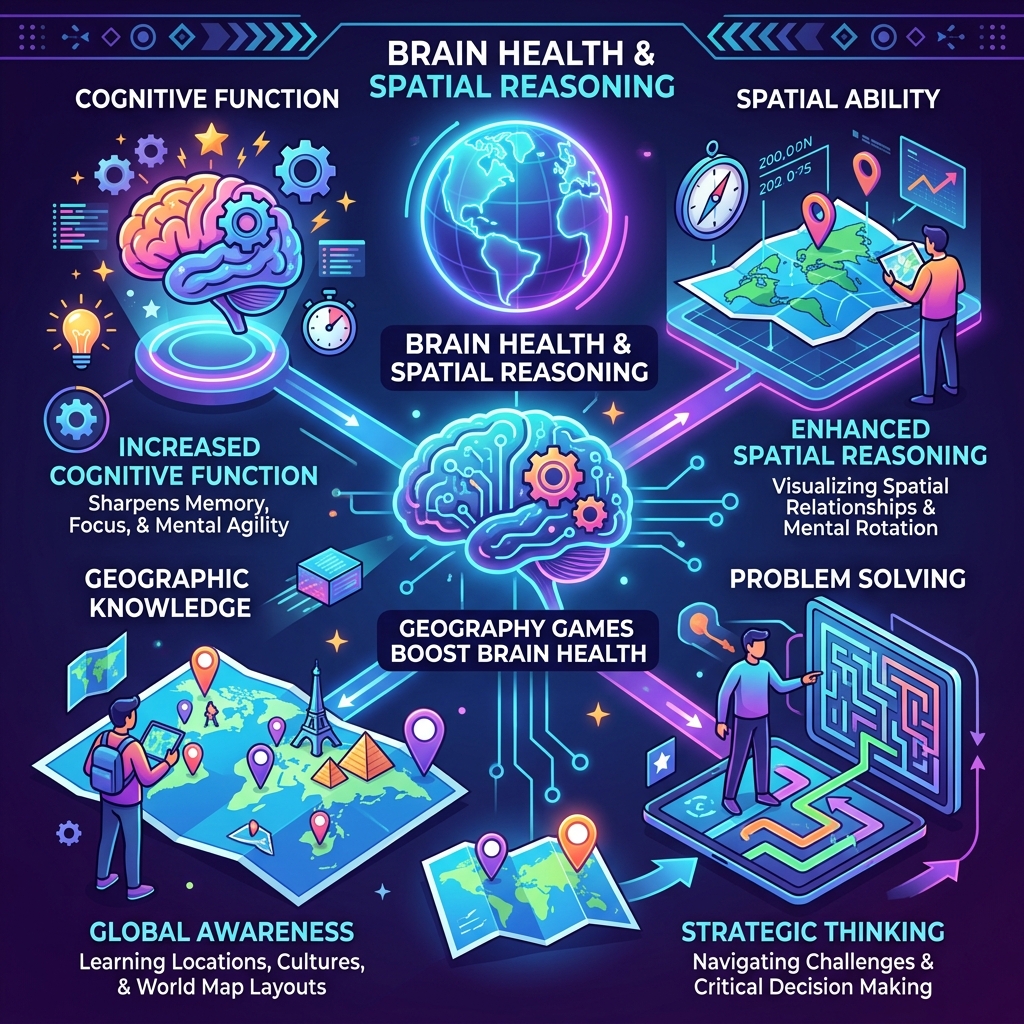
In our modern, hyper-connected world, we rarely need to navigate using our raw cognitive facilities. We rely on step-by-step turn guidance from GPS apps on our smartphones. If we need to find a local coffee shop or travel to a foreign city, a blue dot guides our movements. While this convenience is undeniable, neuroscientists are beginning to raise flags about the long-term cognitive costs of outsourcing our spatial navigation to algorithms.
Fortunately, interactive games offer a fun and engaging way to reclaim these cognitive pathways. Geography games, such as Globdrop, challenge players to build, retrieve, and refine their internal "cognitive maps." These challenges do much more than teach capitals and border lines—they act as a powerful workout for the brain's navigation centers, particularly the hippocampus.
The Neuroscience of Spatial Cognition
At the core of our ability to navigate the world is the hippocampus, a seahorse-shaped structure deep within the temporal lobe. The hippocampus is responsible for two vital functions: the consolidation of long-term memory and spatial navigation. Inside the hippocampus reside "place cells" (which fire when we occupy a specific location) and "grid cells" (which act as a coordinate system to help us understand where we are in space).
When we use turn-by-turn GPS navigation, we bypass these cells. Research shows that GPS users show lower activity in the hippocampus compared to active navigators. Over time, disuse of these neural pathways can lead to a decrease in hippocampal volume, which is associated with cognitive decline and an increased risk of dementia in later life.
The Famous London Taxi Driver Study
One of the most famous studies in modern neuroscience tracked London taxi drivers, who must memorize "The Knowledge"—a massive mental map of 25,000 streets and thousands of landmarks. MRI scans revealed that successful taxi drivers had significantly larger posterior hippocampi than the general public, proving that intensive spatial learning physically grows the brain.
Building and Training "Cognitive Maps"
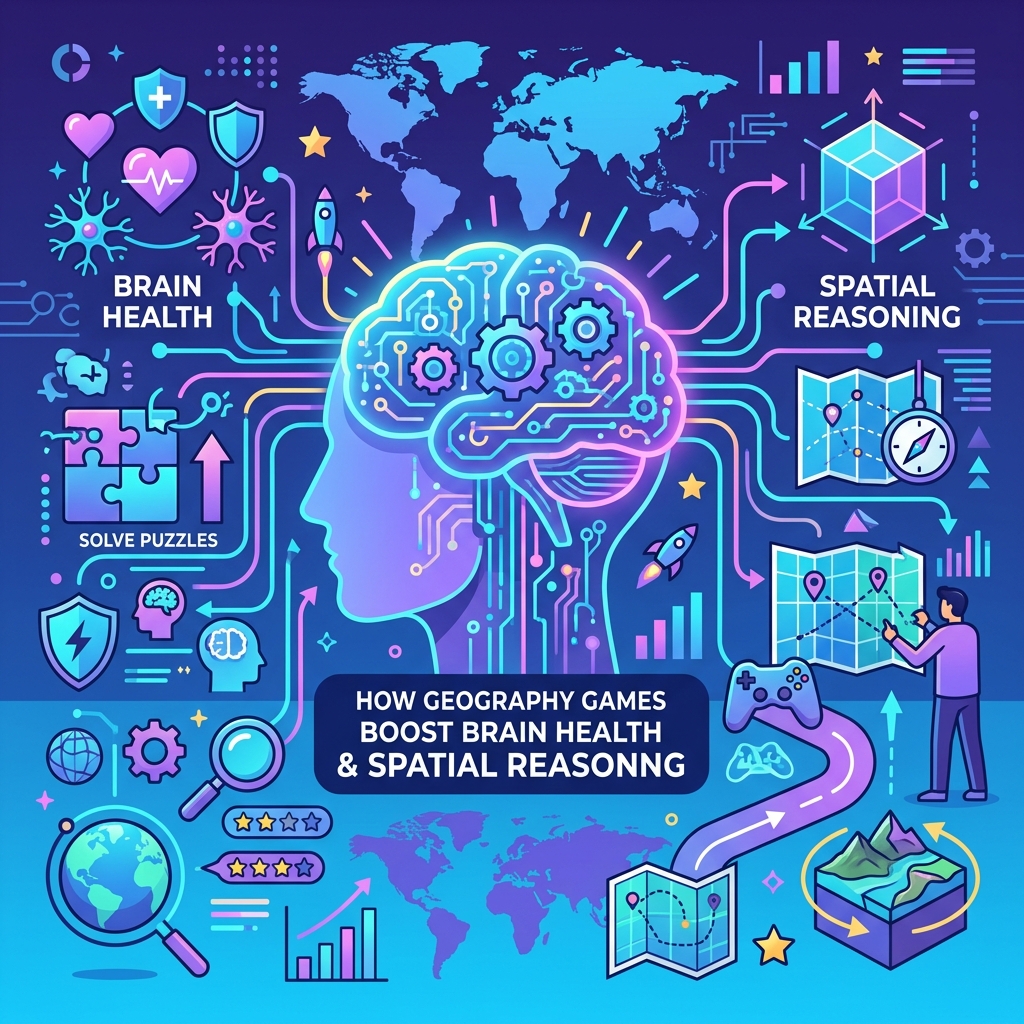
A cognitive map is a mental representation of physical locations and layout. When you play a geography game like Globdrop, you are constantly exercising your cognitive mapping skills through several key mechanisms:
1. Multiscale Spatial Scaling
In Globdrop, you might be asked to pinpoint a global landmark like the Taj Mahal, followed immediately by locating a tiny municipality on a regional map. This forces your brain to dynamically scale its coordinate systems, switching rapidly from global continental perspectives to highly localized terrain outlines. This mental resizing stimulates neural plasticity across different subfields of the hippocampus.
2. Triangulation and Geometric Reasoning
Placing an item precisely on a blank or simplified SVG map requires coordinate triangulation. You must assess relative distances from known anchors (like coastlines, major rivers, or capital cities) to guess the position of the target location. This recruits the parietal lobe, which processes visual-spatial relationships and coordinates spatial attention.
3. Active Recall under Time Constraints
Passive study (like reading an atlas) only goes so far. Active recall—forcing the brain to retrieve location data from memory under pressure—strengthens synaptic connections. The scoring system in Globdrop rewards speed and precision, creating a feedback loop that encourages the brain to build stronger, more easily retrievable memory paths.
Cognitive Benefits Beyond Geography
The neural networks trained by geography games are not siloed; they share pathways with other cognitive domains. Regular training of spatial reasoning has been shown to produce transfer benefits in several areas:
- Working Memory: Holding coordinates and landmarks in mind while calculating distance limits cognitive load and increases short-term recall capacity.
- Executive Control: Deciding how to budget time between searching and committing to a guess strengthens decision-making networks.
- Mathematical Reasoning: Spatial visualization skills are strongly correlated with mathematical ability, as both require manipulating abstract coordinate grids in the mind.
Incorporating Brain Training into Your Routine
You don't need to spend hours memorizing maps to see these cognitive benefits. Just 10 to 15 minutes of active mapping play per day can significantly boost spatial awareness. Here are a few tips to maximize your brain workout:
- Vary Your Scenarios: Don't just play the maps you are good at. If you know Europe well, switch to the Skyscrapers scenario or the Middle-earth map. Novelty is a primary driver of brain-derived neurotrophic factor (BDNF), which supports the growth of new neurons.
- Analyze Your Errors: Spend a moment looking at the feedback screen. Seeing the vector line showing the distance between your click and the correct coordinates helps your brain recalibrate its spatial models.
- Ditch the GPS Occasionally: Put your phone away on familiar routes and let your hippocampus do the driving.
Conclusion
Geography games are far far more than a fun distraction. They are a direct countermeasure to the cognitive passivity encouraged by modern technology. By challenging ourselves to locate cities, landmarks, and borders, we keep our spatial reasoning sharp, protect our hippocampus, and foster a deeper, more structured appreciation of the world around us. So next time you play a round of Globdrop, remember: you aren't just dropping pins—you're building a stronger brain.