How Spatial Reasoning Improves Overall Cognitive Function
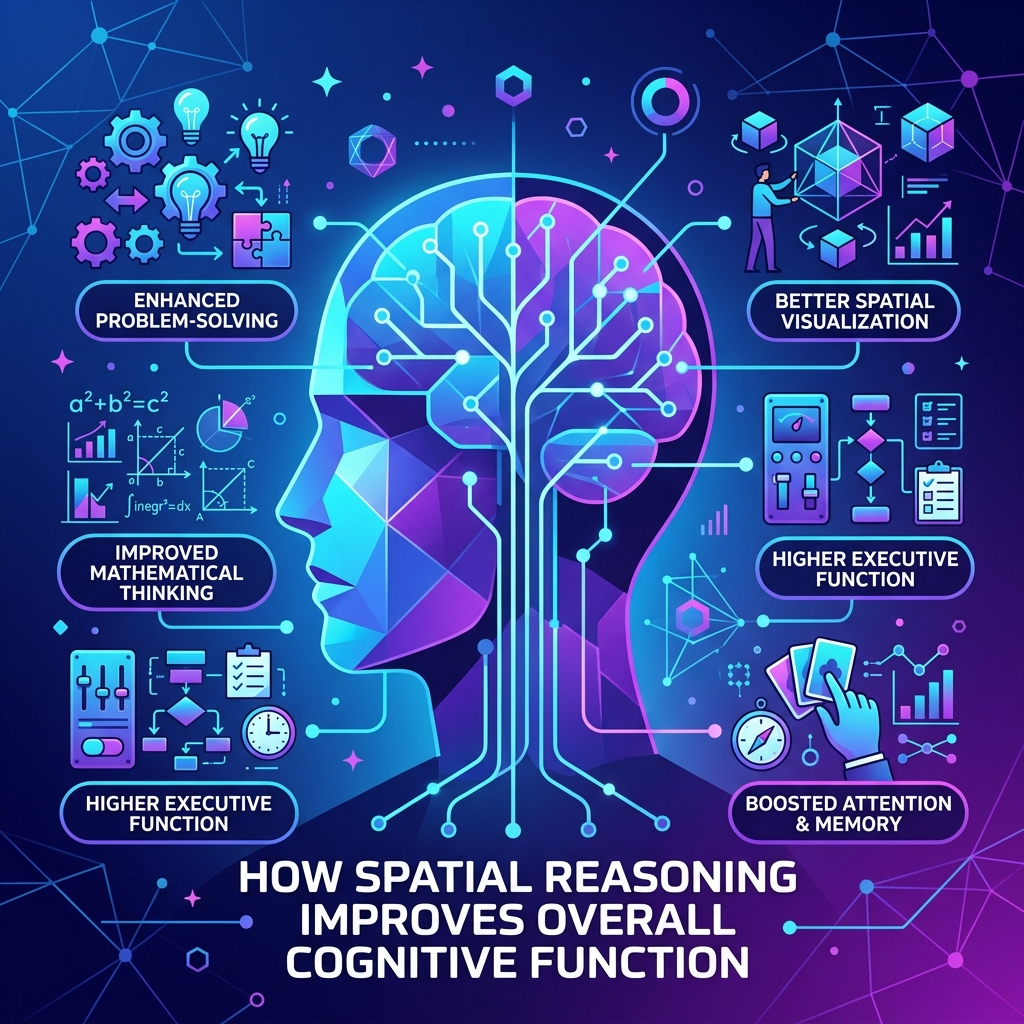
When we think of intelligence, we often default to verbal fluency or mathematical prowess. We praise those who can articulate complex arguments or solve equations rapidly. Yet, there is a third pillar of human intellect that is equally critical but often overlooked in traditional education: spatial reasoning.
Spatial reasoning (or spatial intelligence) is the ability to mentally visualize, manipulate, and understand the relationships between objects in two-dimensional or three-dimensional space. It's the skill you use when packing the trunk of a car, reading a map, or assembling IKEA furniture. But recent neuroscientific research reveals that spatial reasoning is far more than just a practical life skill—it is a foundational cognitive engine that drives performance across a wide spectrum of mental tasks.
The Anatomy of Spatial Thought
Spatial processing is primarily handled by the right hemisphere of the brain, heavily engaging the parietal lobe. This region acts as a sensory integration hub, mapping where objects are in relation to your body and to each other. When you mentally rotate a shape or estimate the distance between two cities on a map, your parietal network fires rapidly.
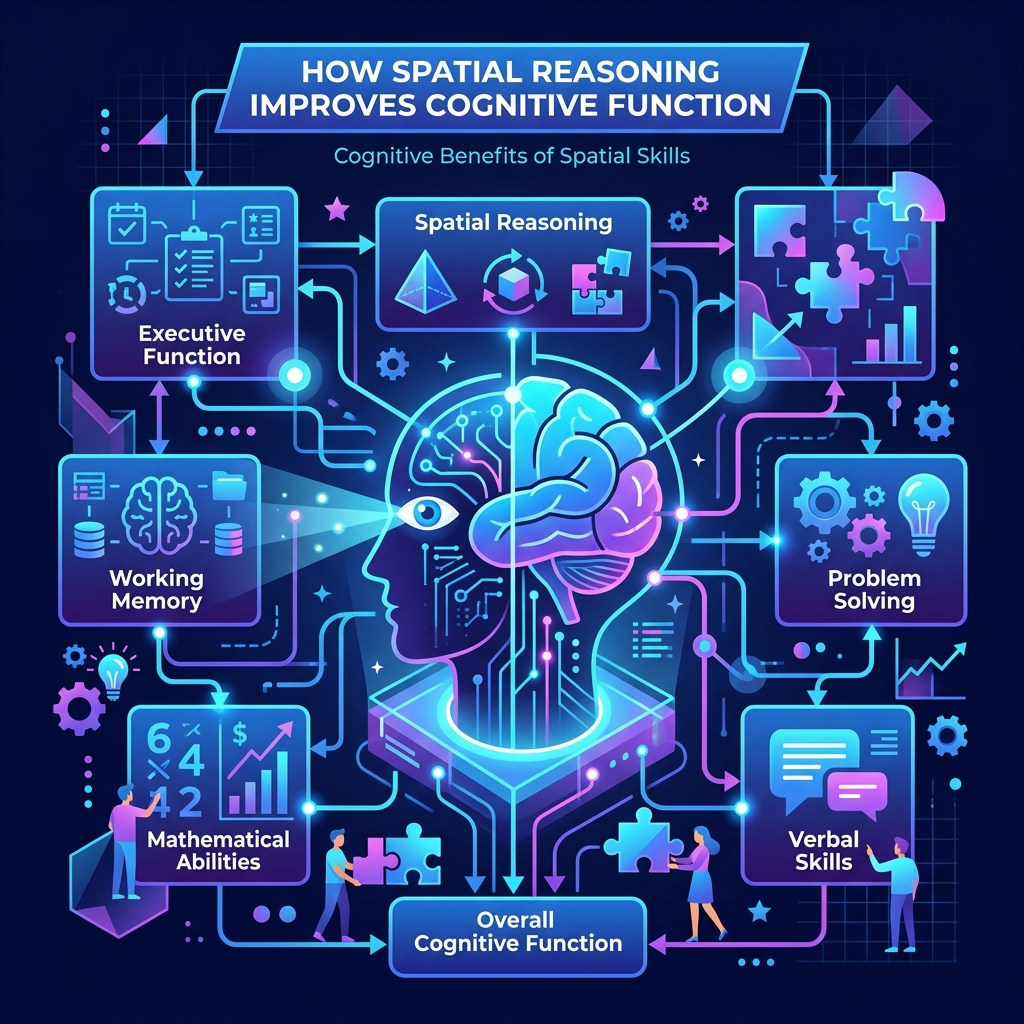
Crucially, this network does not work in isolation. Spatial reasoning demands significant input from the prefrontal cortex (responsible for working memory and executive function) and the hippocampus (the brain's center for navigation and long-term memory). Because spatial tasks require coordination across these major brain regions, practicing them acts like a full-body workout for the mind.
The Gateway to STEM Success
One of the most robust findings in educational psychology is the strong correlation between spatial reasoning skills in early childhood and later success in STEM (Science, Technology, Engineering, and Mathematics) fields.
Think about what STEM professionals actually do: chemists visualize complex 3D molecular structures; architects design buildings in three-dimensional space; software engineers map out data structures and system architectures. Even abstract mathematics relies heavily on spatial metaphors (e.g., number lines, geometry, calculus graphs).
A landmark 50-year longitudinal study known as the Study of Mathematically Precocious Youth (SMPY) found that spatial ability assessments were highly predictive of the number of patents filed and peer-reviewed STEM papers published by participants decades later, even more so than standard math or verbal test scores.
Spatial Training Enhances Working Memory
Working memory is the brain's temporary workspace—it determines how much information you can hold and manipulate simultaneously. Spatial tasks, such as tracking multiple moving objects or remembering a complex route, place a high demand on the visuospatial sketchpad, a key component of working memory.
Studies have shown that regular engagement in spatially demanding activities (like playing spatial puzzle games, using complex interactive maps like Globdrop, or engaging in 3D modeling) can increase working memory capacity. As this capacity grows, so does your ability to focus, ignore distractions, and solve complex, multi-step problems in entirely unrelated domains.
Protecting Against Cognitive Decline
As we age, cognitive decline often manifests first in our spatial abilities. Older adults frequently report difficulties with navigation, spatial memory, and recognizing complex visual patterns. This is partly due to age-related atrophy in the hippocampus.
However, the brain remains plastic throughout life. Engaging in challenging spatial tasks helps build cognitive reserve. By repeatedly firing the neural pathways associated with spatial mapping and rotation, you stimulate the production of neurotrophic factors that promote the survival of neurons and synapses. Actively navigating a new city, reading physical maps, or playing geography-based positioning games forces the brain to continuously update its internal models, acting as a buffer against neurodegenerative diseases like Alzheimer's.
How to Train Your Spatial Brain
The good news is that spatial intelligence is highly malleable. It is not a fixed genetic trait, but a skill that responds remarkably well to training. Here are practical ways to enhance it:
- Play Spatial Games: Puzzles like Tetris, 3D platformers, and geography placement games require continuous mental rotation and distance estimation.
- Read Physical Maps: Turn off the GPS turn-by-turn navigation. Look at a map, plan your route, and try to navigate using landmarks and an internal compass.
- Sketch and Draw: Attempting to represent 3D objects on a 2D piece of paper forces the brain to grapple with perspective, scale, and proportion.
- Build Things: Whether it's Lego, woodworking, or origami, translating 2D instructions into 3D physical objects is premier spatial training.
Conclusion
Spatial reasoning is the silent workhorse of human cognition. By taking the time to actively challenge our spatial processing networks—whether through educational geography games, architectural hobbies, or simply navigating without digital assistance—we do more than improve our sense of direction. We upgrade the underlying hardware of our brains, sharpening our memory, boosting our analytical skills, and building resilience for the future.