How Navigation Apps Are Changing Our Hippocampus
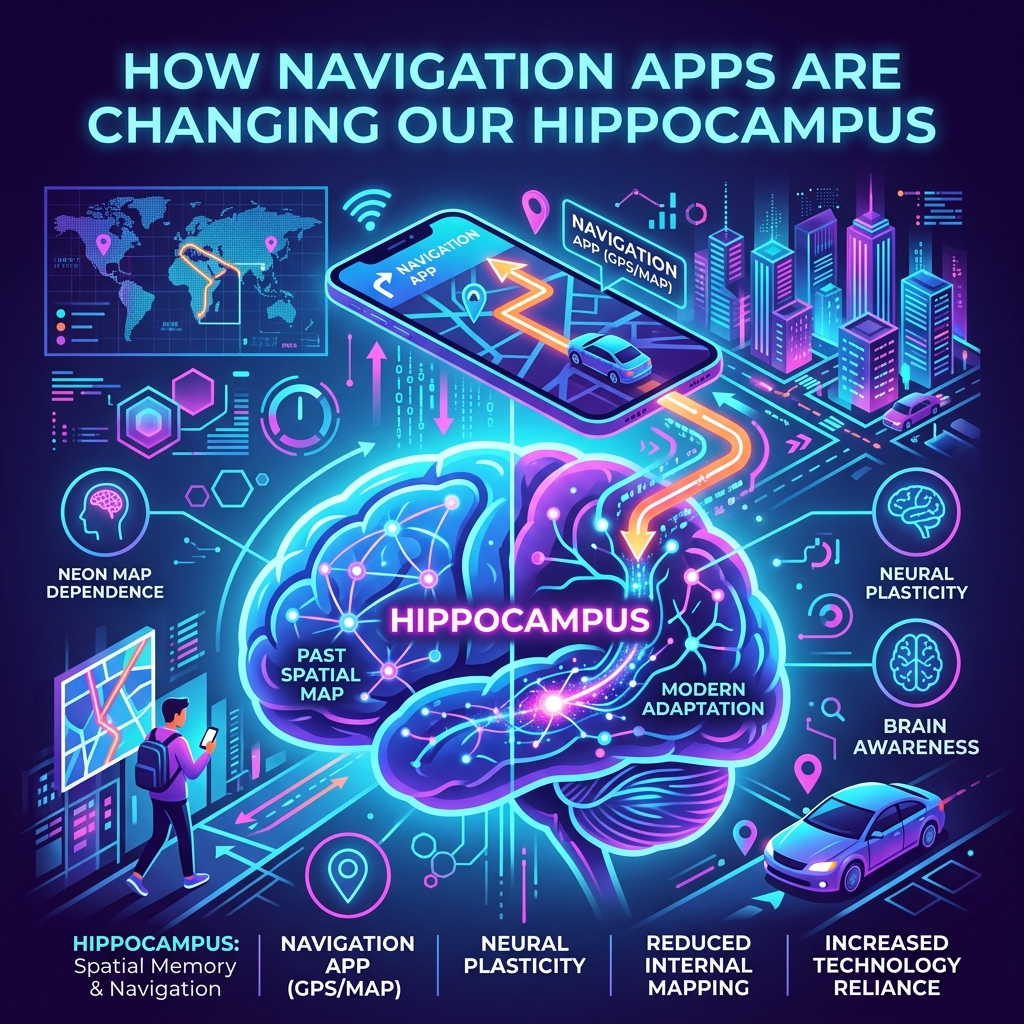
Imagine being dropped in the center of an unfamiliar city without your smartphone. For most modern adults, this thought induces mild panic. Over the last two decades, GPS technology and turn-by-turn navigation apps have become so ubiquitous that we rarely engage in raw, unassisted wayfinding. While the convenience of a blue dot guiding us to our exact destination is undeniable, neuroscientists are discovering that this convenience comes with a hidden biological cost.
The Brain's Internal GPS
To understand the impact of digital navigation, we must look deep into the temporal lobe at a structure called the hippocampus. The hippocampus is the brain's central processing unit for spatial memory and navigation. It contains specialized neurons—"place cells" that fire when you are in a specific location, and "grid cells" that provide a mental coordinate system.
When you navigate a city using your own cognitive map—identifying landmarks, remembering street names, and calculating distance—these cells fire rapidly, strengthening synaptic connections. This active mapping process physically alters the brain. The famous study on London taxi drivers demonstrated that drivers who memorized "The Knowledge" (a mental map of 25,000 streets) had significantly larger posterior hippocampi than the general population.
The "Outsourcing" Effect
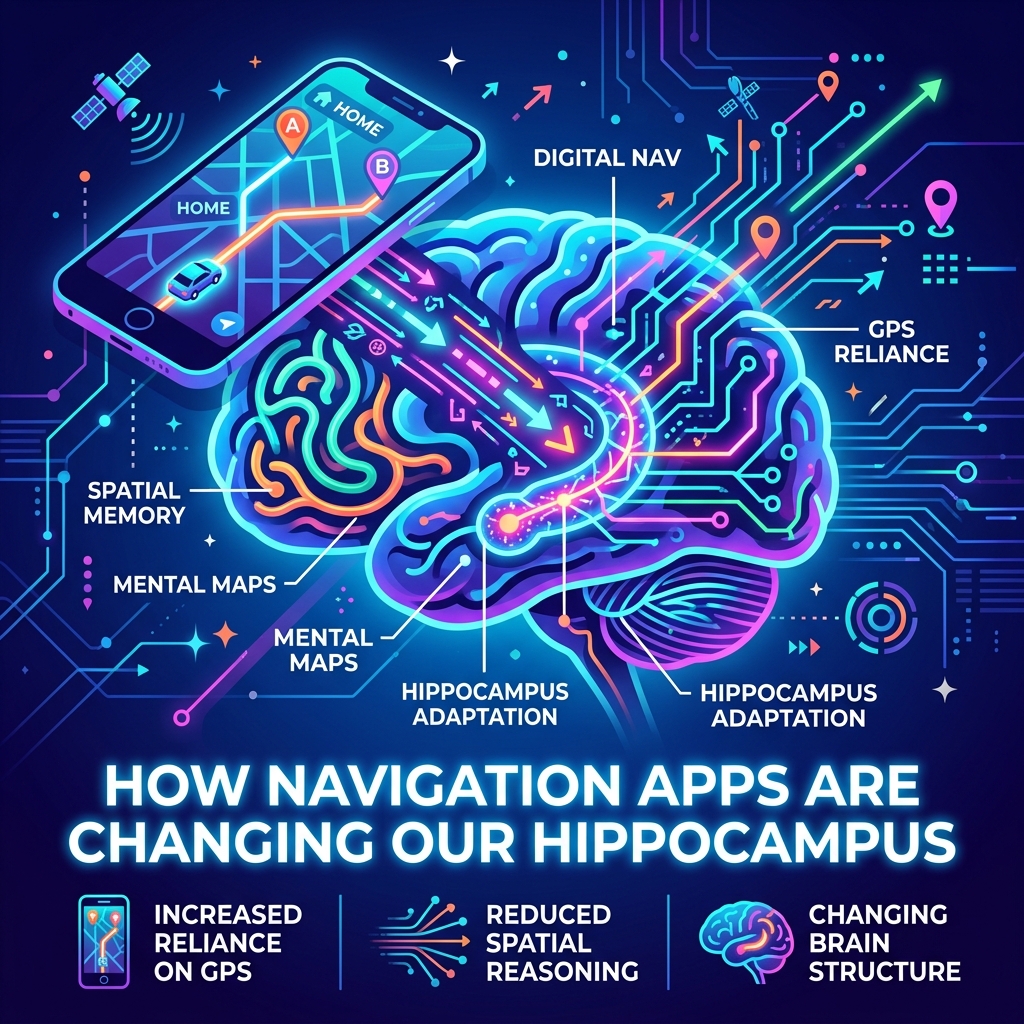
So, what happens when we outsource this process to Google Maps, Apple Maps, or Waze?
A landmark 2017 study conducted by University College London used fMRI scans to monitor the brain activity of subjects as they navigated a simulated city. Half the subjects navigated by memory, while the other half followed a GPS-like display.
The results were striking. In subjects navigating by memory, the hippocampus and prefrontal cortex showed spikes of activity when entering new streets and making routing decisions. In contrast, the brains of the subjects following the GPS showed almost no activity in these regions. When technology tells us which way to go, our brains simply switch off their navigation networks.
Why Does "Switching Off" Matter?
You might argue that outsourcing navigation frees up mental energy for more important tasks. However, the hippocampus doesn't just handle spatial maps; it is also crucial for episodic memory (remembering the events of your life) and imagining the future.
The principle of "use it or lose it" applies heavily to neurobiology. Chronic disuse of the hippocampus can lead to a reduction in its volume and density over time. A shrinking hippocampus is one of the earliest biological markers of Alzheimer's disease and age-related dementia. By constantly using GPS, we are actively depriving our brains of a natural, everyday workout that helps build cognitive reserve.
The Death of the "Survey Knowledge"
Beyond the biological implications, GPS reliance changes how we perceive our environment. Psychologists divide spatial knowledge into two categories:
- Route Knowledge: Knowing a specific sequence of actions (turn left at the light, go straight for two miles, turn right at the gas station).
- Survey Knowledge: Having a top-down, holistic understanding of an area, understanding the relationship between different routes and landmarks.
GPS apps primarily train route knowledge. Because you are only looking at the next step, you never build a cohesive map in your head. This is why you can drive to a new restaurant using GPS three times and still not know how to get there without your phone on the fourth trip. You haven't built survey knowledge; you've merely followed a script.
Reclaiming Your Cognitive Map
You don't have to throw your smartphone in the river to protect your brain. It's about finding a balance between convenience and cognitive effort. Here are a few ways to keep your hippocampus active:
- Pre-plan Your Route: Before you drive, look at the map on your phone. Memorize the main roads and key turns. Then, put the phone away and try to navigate from memory. Only turn on the GPS if you get completely lost.
- The "Way Back" Challenge: Use GPS to get to a new destination, but force yourself to navigate the return trip home entirely from memory.
- Play Spatial Games: Engaging with maps in a low-stakes environment, like playing geography games (such as Globdrop) or solving 3D puzzles, forces your brain to practice survey knowledge and spatial relationships.
Conclusion
Technology has given us the superpower to never be lost again. But feeling a little "lost" is exactly what forces our brains to pay attention, solve problems, and build internal maps. By occasionally turning off the blue dot and relying on our own senses, we preserve not just our sense of direction, but the very structures of our mind.