How to Map Project Dependencies Without Going Crazy
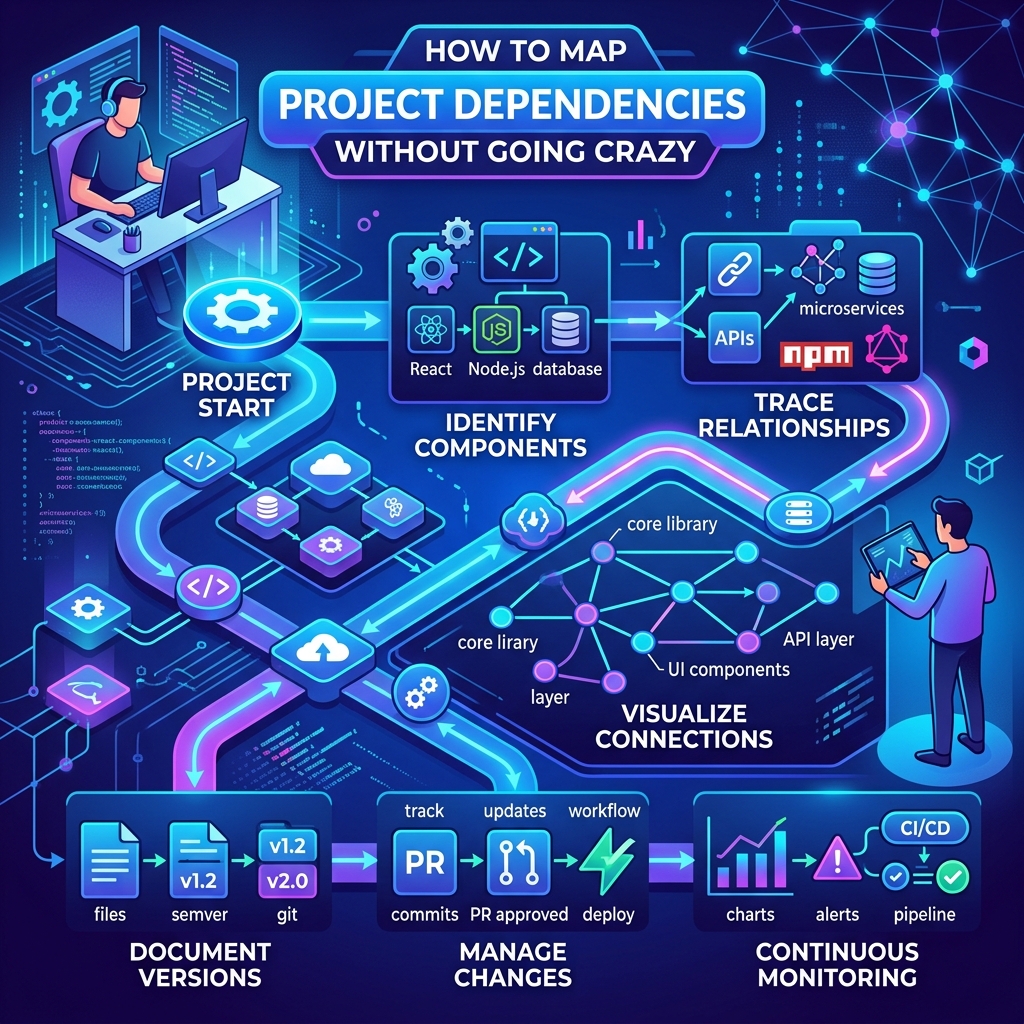
If you've ever managed a project that involves more than one person, you've experienced the "domino effect." A vendor delivers a part two days late. That delays the assembly team by two days. The assembly delay pushes testing into the weekend, which means the QA team isn't available, so testing doesn't happen until Tuesday. Suddenly, a minor 48-hour hiccup has cascaded into a two-week delay for the final launch.
This happens because tasks in a project do not exist in a vacuum; they are connected by dependencies. Understanding and mapping these dependencies is the difference between a project manager who is constantly reacting to fires and one who calmly anticipates them.
The Four Types of Dependencies
Before you can map dependencies, you must understand the language of how tasks relate to each other. In project management, there are four formal types of logical relationships:
1. Finish-to-Start (FS)
This is the most common dependency (accounting for about 90% of relationships). Task B cannot start until Task A finishes.
Example: You cannot begin "Painting the walls" (Task B) until you finish "Installing the drywall" (Task A).
2. Start-to-Start (SS)
Task B cannot start until Task A has started. They don't have to finish at the same time, but their beginnings are linked.
Example: "Writing the user manual" (Task B) can begin as soon as "Software Beta Testing" (Task A) begins.
3. Finish-to-Finish (FF)
Task B cannot finish until Task A finishes.
Example: "Cleaning up the construction site" (Task B) cannot finish until the "Construction work" (Task A) finishes.
4. Start-to-Finish (SF)
The rarest dependency. Task B cannot finish until Task A starts.
Example: "Shift 1 Security Guard" (Task B) cannot finish their shift until "Shift 2 Security Guard" (Task A) starts their shift.
The Danger of the "Mental Map"
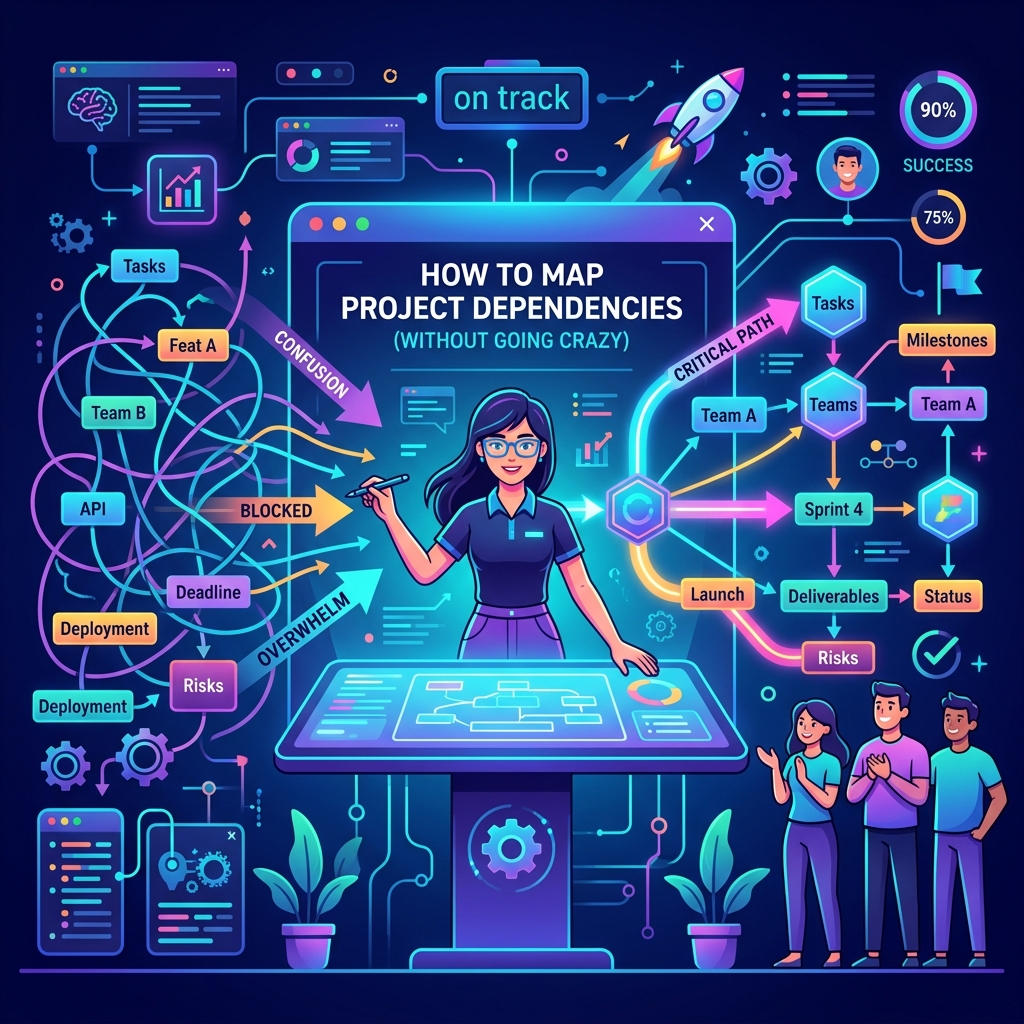
In many small to medium teams, dependencies are managed purely in the project manager's head. The PM knows that Bob can't start coding until Alice finishes the design, so they verbally manage that handoff.
This "mental map" approach is a massive liability. If the PM gets sick, the team loses the project's structural integrity. Furthermore, a human brain cannot accurately calculate the cascading calendar effects of a delay across a 50-task project with branching dependencies. When the map is only in someone's head, the team operates in a state of reactive anxiety.
How to Map Visually
The only effective way to manage complex dependencies is visually, typically using a Gantt chart or a PERT network diagram.
- List All Tasks: Start by getting every single task out of people's heads and onto a board or list. Don't worry about order yet; just brain-dump the scope.
- Identify Predecessors: Go down the list. For every task, ask one simple question: "What absolutely must be completed before this task can begin?" Do not list things that would be "nice" to have done first; list only strict, logical blockers.
- Draw the Lines: Put the tasks on a visual timeline. Draw physical arrows connecting the end of the predecessor task to the beginning of the successor task. In digital tools like Vedratic Project Manager, this is usually a drag-and-drop action.
- Find the Critical Path: Once all dependencies are linked, the software will reveal your Critical Path—the longest sequence of dependent tasks that determines the absolute minimum time needed to complete the project. If any task on the critical path is delayed, the final deadline is delayed.
Adding Reality: Lag and Lead Time
A good dependency map accounts for the real world using Lag and Lead times.
- Lag Time: A mandatory waiting period between dependent tasks. If Task A is "Pour concrete foundation" and Task B is "Build wooden frame," there is an FS dependency. But you must add a 3-day Lag Time for the concrete to cure before Task B can actually start.
- Lead Time: An acceleration overlapping dependent tasks. If Task A is "Write 10 chapters of a book" and Task B is "Edit the book," you don't have to wait for all 10 chapters to be finished to start editing. You can add a Lead Time, allowing editing to begin when writing is 50% complete.
Conclusion
Mapping dependencies might feel like tedious administrative overhead at the beginning of a project. However, an hour spent drawing arrows on a timeline will save you weeks of confusion, idle waiting time, and blown deadlines down the road. It forces the team to confront the logical reality of their plan before a single line of code is written or a single nail is hammered.