The Psychology of Deadlines: Parkinson's Law
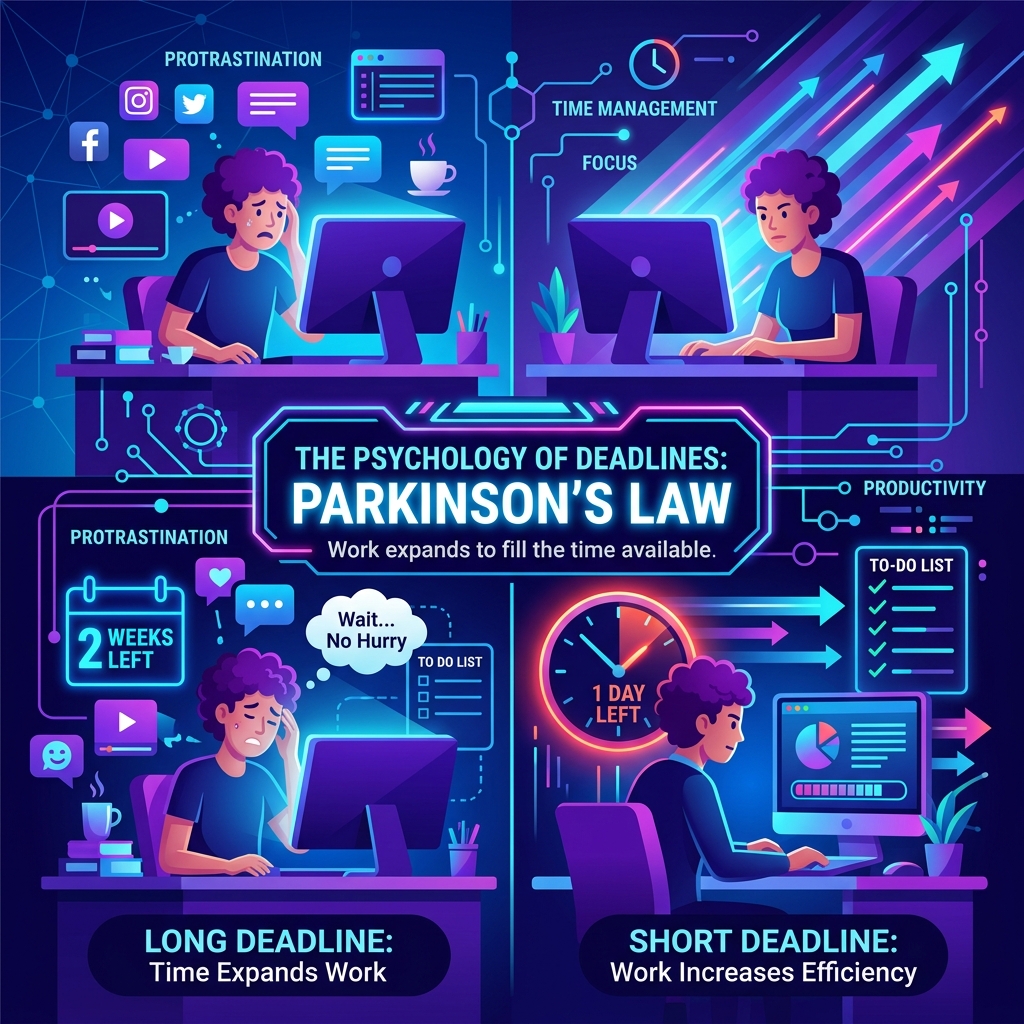
In 1955, a British naval historian and author named Cyril Northcote Parkinson published a satirical essay in The Economist. In it, he coined an adage that would become one of the most famous maxims in modern business: "Work expands so as to fill the time available for its completion."
This concept, now universally known as Parkinson’s Law, highlights a bizarre psychological quirk in how humans approach tasks. Give a team two weeks to redesign a landing page, and it will take exactly two weeks. Give that same team two months to redesign the identical landing page, and it will take exactly two months. The quality of the two-month page will not be proportionately better; the time will simply be absorbed by overthinking, unnecessary revisions, and administrative bloat.
Why Does the Work Expand?
Parkinson's Law isn't about laziness. Most professionals don't stretch a two-week task into two months by watching YouTube at their desks. The work expands because of perfectionism, scope creep, and the anxiety of the "final deliverable."
- The Polish Trap: If an engineer finishes the core logic of a feature in 3 days but has 7 days left before the deadline, they will spend those 7 days endlessly refactoring, optimizing things that don't need optimization, and chasing diminishing returns.
- The Bureaucratic Swell: More time invites more opinions. A one-week project is usually executed by a small, autonomous team. A two-month project inevitably attracts managers, stakeholders, and legal reviews, creating a tangled web of meetings that artificially inflates the effort required.
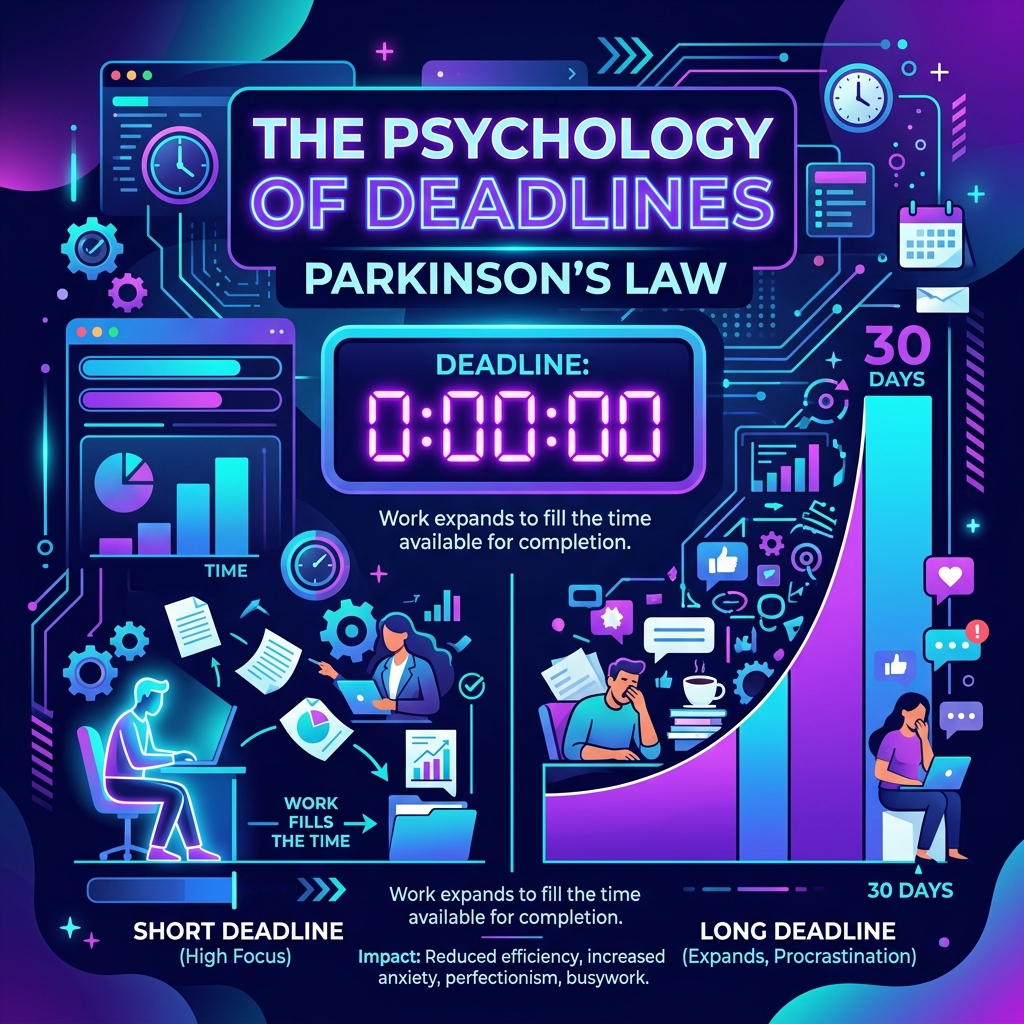
- The Student Syndrome: This is a corollary to Parkinson's Law. If you give someone 30 days to do a 5-day task, they won't do it slowly over 30 days. They will procrastinate for 25 days and then panic-work for the last 5 days.
Using Parkinson's Law as a Weapon
If work expands to fill the time allotted, the logical solution is to shrink the time allotted. In project management, this is known as Timeboxing.
Timeboxing flips the traditional estimation model. Instead of asking, "How long will it take to build the perfect feature?", you ask, "What is the most valuable version of this feature we can build in exactly 14 days?"
This is the psychological engine that drives Agile methodologies like Scrum. By creating strict, unmovable 2-week sprints, you force the team to ruthlessly prioritize. Perfectionism is banished because there simply isn't time for it. The team must ship the Minimum Viable Product (MVP) before the clock runs out.
Visualizing the Box
Managing Parkinson's Law requires high visibility. If deadlines are vague or hidden in a spreadsheet, the psychological pressure of the timebox dissipates, and the work expands.
When you place tasks on a visual Gantt chart, you are drawing a literal, spatial box around the work. A developer looks at the timeline and sees that their task bar ends on Thursday, and a critical dependency bar begins on Friday. The spatial reality of the chart creates a healthy, immediate urgency that combats the Student Syndrome procrastination.
The Danger of Over-Constriction
A word of warning: While shrinking the timebox prevents bloat, compressing it beyond physical reality creates burnout and technical debt (as discussed in our article on "Phantom Deadlines"). The goal is to find the "Goldilocks Zone"—a deadline that is aggressive enough to enforce focus and prevent over-engineering, but realistic enough to allow for quality execution.
Conclusion
Parkinson’s Law is a reminder that time estimation is as much a psychological discipline as it is a mathematical one. By understanding that human beings will naturally consume all the runway you give them, you can structure your projects with artificial scarcity. Tighten the deadlines, define the scope strictly, and watch your team's efficiency soar.