Building a Culture of Accountability with Transparent Timelines
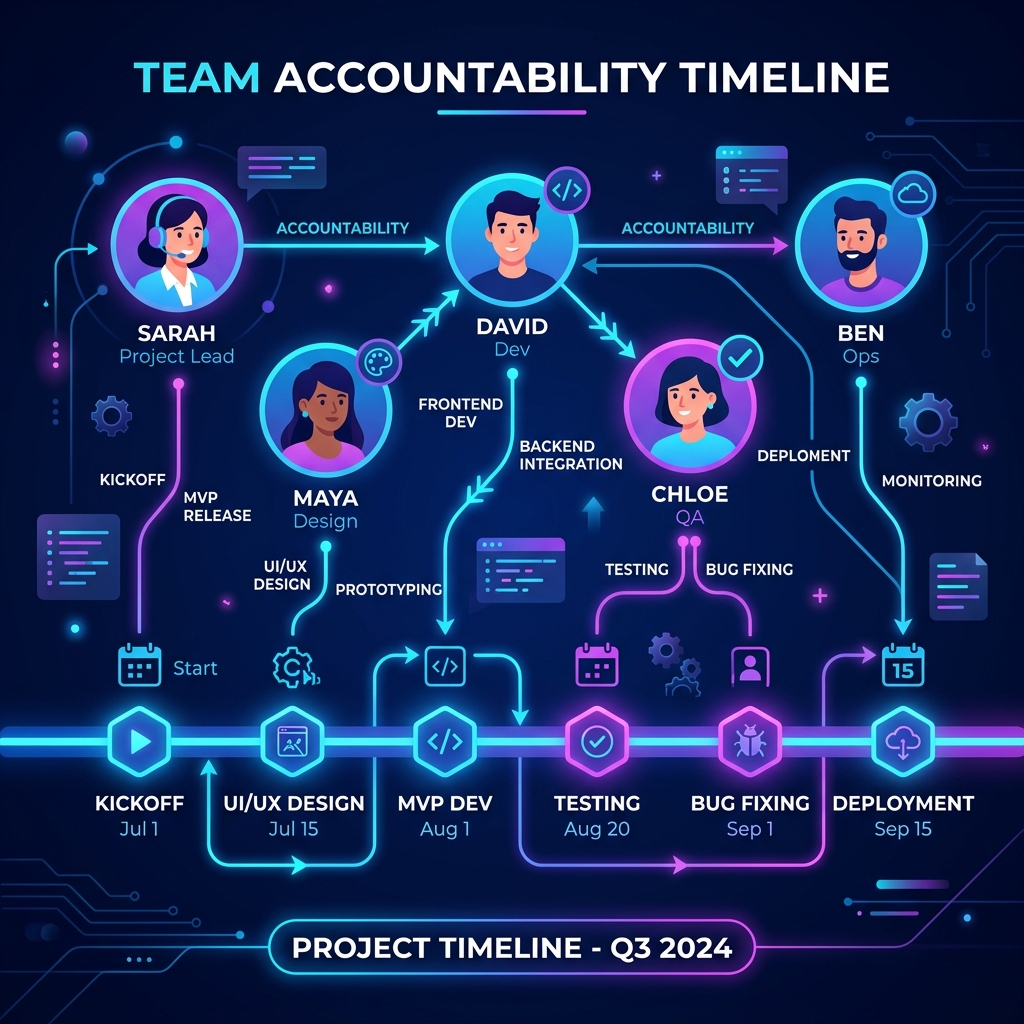
One of the most persistent myths in management is that accountability requires constant surveillance. We imagine the archetypal "strict boss" who demands daily status reports, hovers over desks (or Slack statuses), and micromanages every hour of the team's day to ensure work gets done.
In reality, this approach destroys accountability. When a manager becomes the sole enforcer of deadlines, the team abdicates responsibility. Their goal shifts from "delivering a great product on time" to "appeasing the manager." If the manager forgets to ask for an update, the work stalls.
True accountability cannot be forced from the top down; it must be generated laterally by the team itself. The most effective tool for generating this lateral accountability is radical transparency, specifically through visual, shared timelines.
The Power of the Public Board
When a project is managed via private spreadsheets, direct messages, and siloed 1-on-1 meetings, nobody knows how their work affects the rest of the company. If a backend engineer finishes an API three days late, they might assume it's no big deal—they don't see the downstream consequences.
But when you manage a project on a public, visual Gantt chart accessible to everyone from the junior developers to the CEO, the dynamic changes instantly.
When the timeline is transparent, the backend engineer can literally see that their specific API task is connected by a dependency arrow to the frontend team's work. They can see that if their task bar slides to the right by three days, the frontend team's start date also slides, pushing the entire project launch date into the red.

Lateral Accountability: The "I Owe You" Effect
Human beings are deeply social creatures. We generally dislike letting our peers down far more than we dislike disappointing an abstract authority figure.
Visual dependencies trigger this social instinct. When an employee knows that Sarah cannot start her job until they finish theirs, and both of them can see that dependency on the master timeline, a powerful psychological contract is formed. The employee works hard to finish on time not because the boss told them to, but because they owe it to Sarah.
Eliminating the "Status Update" Meeting
Transparent timelines eliminate the need for the most dreaded corporate ritual: the round-robin status meeting. You know the meeting—eight people sit in a room while each person spends five minutes justifying their existence and reading off a list of things they accomplished.
When the timeline is visual and continuously updated, the status is self-evident. If a bar is green, it's done. If it's blue, it's on track. If it's red, it's late. You don't need a meeting to discover the status. Instead, the meeting transforms into a high-value problem-solving session. "I see on the board that the design phase is glowing red. What is the specific blocker, and how can the rest of us help unblock you?"
Transparency as Psychological Safety
Ironically, exposing everyone's deadlines to the entire company actually increases psychological safety.
In opaque systems, delays are often hidden out of fear, snowballing until they cause a catastrophic failure right before launch. In a transparent system, delays are visible early and treated as structural problems rather than moral failings. If an engineer's task is taking twice as long as estimated, the visual timeline makes it obvious immediately. The manager can intervene not to punish the engineer, but to ask: "Was the estimate wrong? Do you need a junior dev to pair with you? Should we cut scope?"
Conclusion
You cannot buy accountability, and you certainly cannot mandate it through micromanagement. You build it by treating your employees like adults. Show them the big picture. Show them exactly how their specific piece of the puzzle fits into the whole. Give them the tools to see how their delays affect their teammates. When you illuminate the timeline, the team will manage themselves.