Beyond the Critical Path: Buffer Management in Engineering
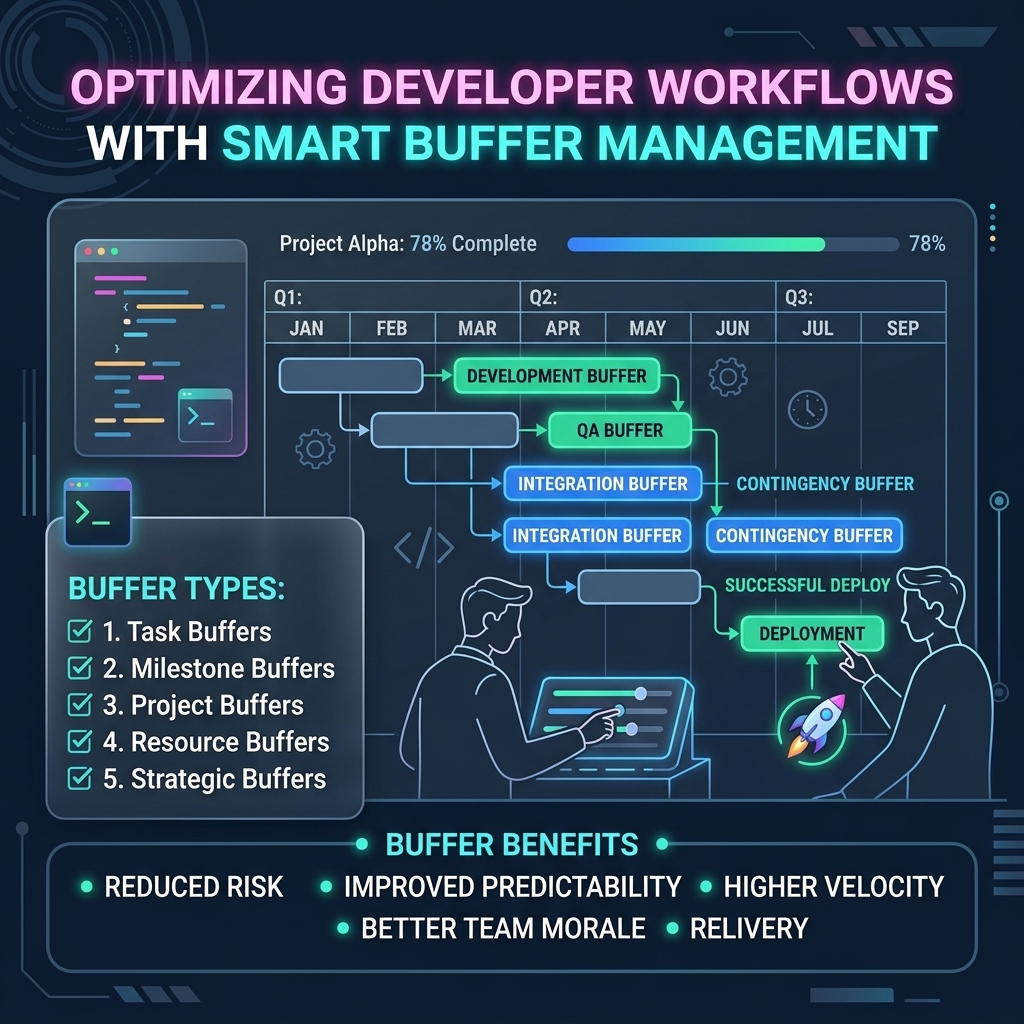
For over half a century, the **Critical Path Method (CPM)** has been the undisputed king of project planning. Whether building a bridge or deploying a distributed microservice architecture, managers instinctively draw a network of dependent tasks, identify the longest continuous chain of dependencies, and declare that sequence the 'critical path.'
Yet, in software engineering, critical path schedules miss deadlines with astonishing regularity. Why? Because traditional CPM assumes that task duration estimates are deterministic and static. When an engineering team estimates that an authentication refactor will take five days, that number almost never represents the absolute minimum work time; it represents the work duration plus a hidden layer of padding intended to absorb unforeseen technical debt, API rate-limiting surprises, and code review bottlenecks.
At Vedratic, while building our **Project Manager** browser app, we designed our timeline engine around a more robust methodology: **Critical Chain Project Management (CCPM)** and localized safety buffer distribution. Here is why stripping padding from individual tasks and consolidating it into strategic buffers changes the game for software delivery.
The Hidden Traps of Task-Level Padding
When engineers or project managers embed safety margins directly inside individual task estimates, three psychological and operational laws conspire to waste that extra time:
1. Parkinson's Law
"Work expands so as to fill the time available for its completion." If a developer finishes a five-day estimated task in three days, they rarely push the deliverable to production early. Instead, the remaining two days are consumed by scope creep, unnecessary refactoring, or gold-plating features until the timer runs out.
2. Student Syndrome
Knowing that a task contains generous safety padding, engineers often delay deep-focus work until the final stretch before the deadline. Consequently, any genuine unexpected blocker discovered on day four immediately breaches the estimated window because the built-in padding was already squandered in early procrastination.
3. The Dependency Accumulation Trap
In a dependent chain of tasks (`Task A -> Task B -> Task C`), early finishes almost never pass their saved time forward because downstream developers aren't ready to start ahead of schedule. However, delays accumulate instantly and propagate down the entire critical chain.
The Critical Chain Solution: Localized Safety Buffers
Critical Chain Project Management addresses these traps by fundamentally changing how duration estimates and safety margins are structured. Instead of asking teams for 'safe' estimates that include hidden padding, managers ask for aggressive **50% confidence estimates**—the duration where the task is equally likely to finish early or late assuming zero distractions.
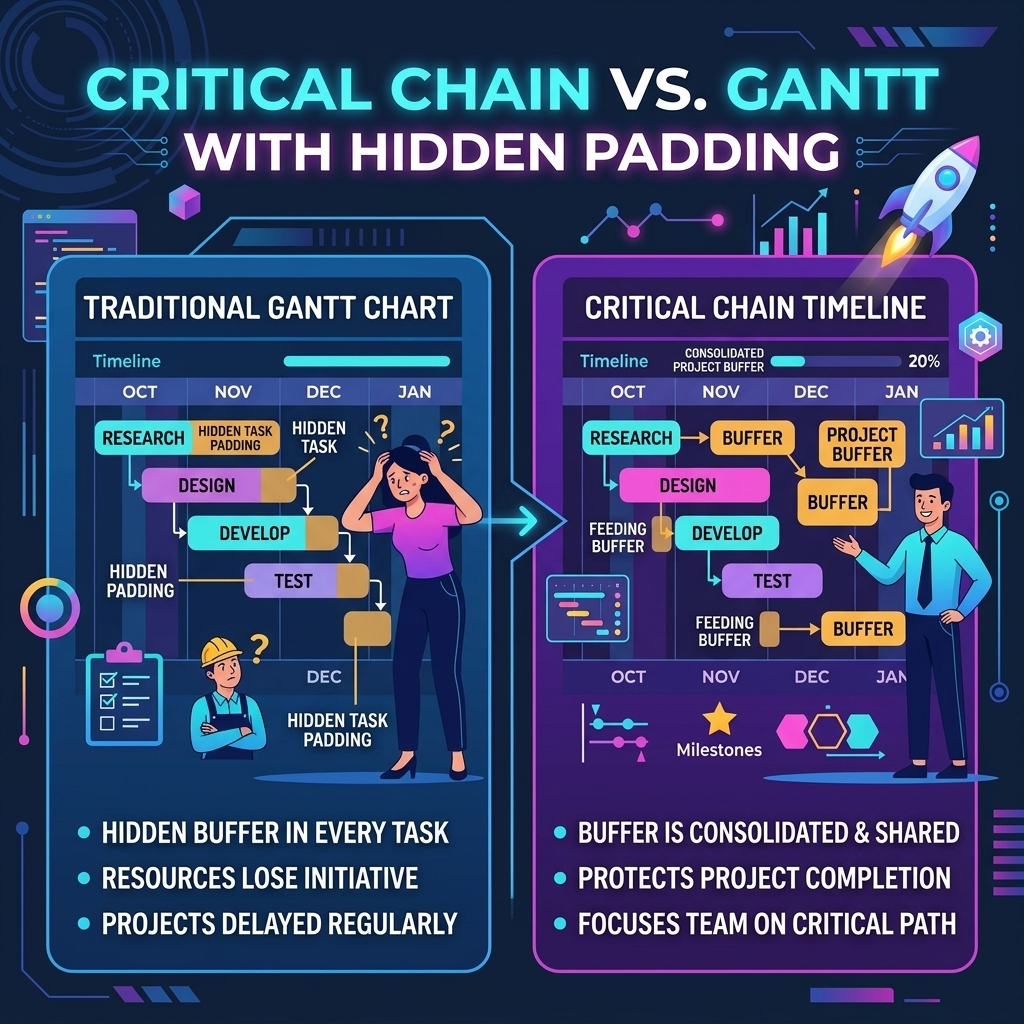
The safety time stripped from individual tasks is not discarded. Instead, it is aggregated and inserted into explicit, visible **buffers** across the schedule hierarchy:
- Project Buffer: Placed at the very end of the critical chain right before the final release date. This protects the external commitment date from variation across the longest sequence of dependent tasks. Because statistical variances cancel out over multiple independent tasks (`Central Limit Theorem`), the aggregated project buffer only needs to be about 50% of the sum of the individual task safety margins.
- Feeding Buffers: Inserted wherever a non-critical side path merges into the main critical chain. Feeding buffers ensure that delays on secondary tasks (such as writing documentation or configuring CI/CD pipelines) never spill over and interrupt the primary engineering track.
- Resource Buffers: Alert milestones that signal critical specialists (such as database architects or security auditors) a few days in advance so they can clear context-switching friction before critical chain handoffs arrive.
Visualizing Buffers inside Vedratic Project Manager
Most commercial project planning tools hide buffer mechanics behind rigid start/end date pickers. When designing the timeline editor in **Vedratic Project Manager**, we elevated explicit buffer blocks to first-class visual elements.
In our tool, buffer consumption is tracked dynamically using a **Fever Chart** metric. Rather than asking *“Are we on schedule?”*—which is often misleading when individual tasks fluctuate—team leads monitor the ratio of **Critical Chain Progress** against **Buffer Consumption Index**. If 40% of the project buffer is consumed when only 20% of the critical chain is completed, the visual planner highlights the bottleneck chain in amber, allowing managers to reallocate resources long before the final deadline is compromised.
Conclusion
Software development is an inherently creative and uncertain discipline. Attempting to force exact predictability onto every micro-task via padded estimates creates rigid, bloated schedules that still miss their target dates. By shifting your planning philosophy to Critical Chain methodology and managing localized buffers explicitly, your engineering team can move faster, communicate realistic expectations with stakeholders, and deliver software with confidence.