Why We Still Need to Learn Geography in the Digital Age
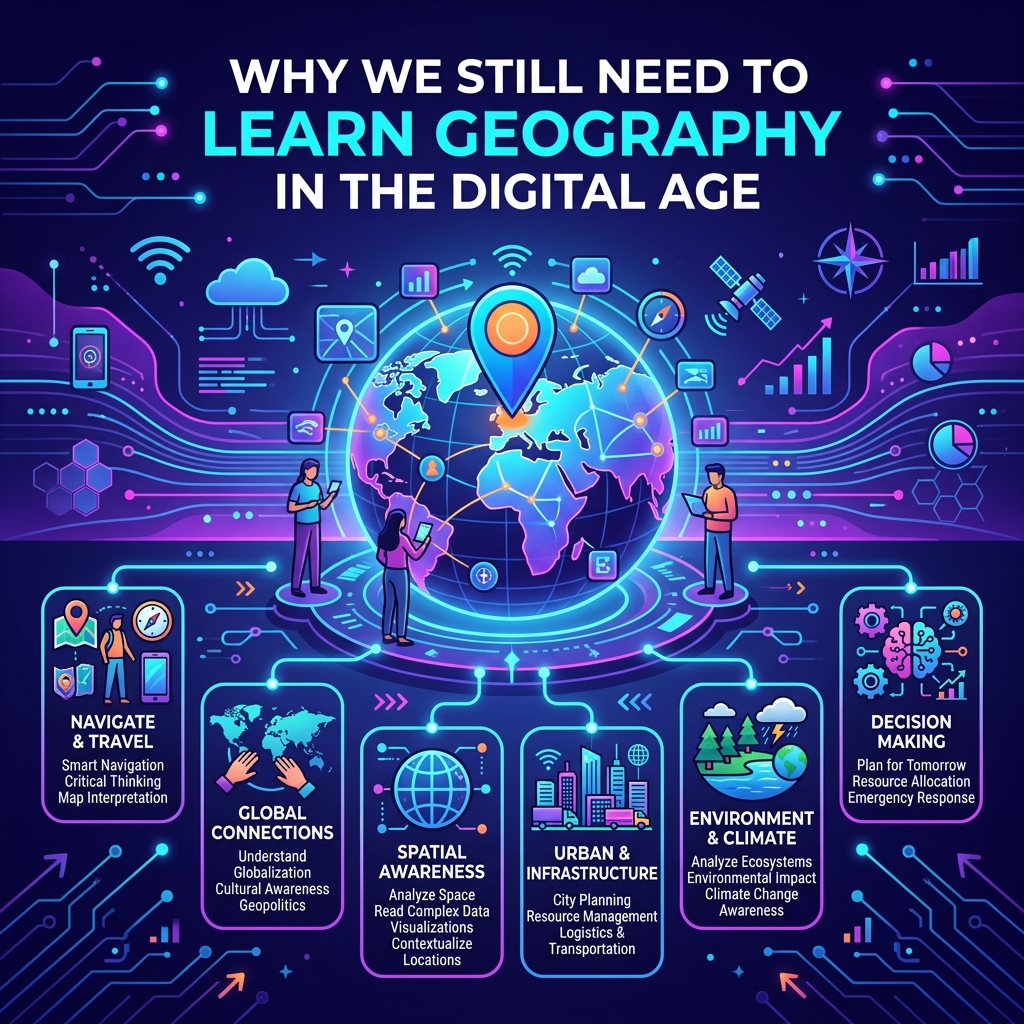
There is a common, cynical question asked by students staring at a blank map of the world: "Why do I need to know where Uzbekistan is if I can just look it up on my phone?"
It’s a fair point. We live in an era of unprecedented digital access. You can pull up a high-definition satellite image of a street corner in Tokyo from your couch in London in three seconds. GPS ensures you will never physically lose your way. So, does rote memorization of country borders, capitals, and mountain ranges still matter?
The answer is a resounding yes. Learning geography is not about navigation; it is about building a framework for understanding the world. Here is why geographic literacy is more critical now than ever before.
Geography is the Stage for History and Geopolitics
You cannot understand the news without a spatial framework. When you read a headline about a conflict in the South China Sea, the political tension only makes sense if you understand the geographic reality: the proximity of China, Taiwan, the Philippines, and Vietnam, and the strategic importance of those shipping lanes.
Why has Russia historically obsessed over the Crimean Peninsula? Because a look at the map reveals it is their primary warm-water port for fleet access to the Mediterranean. Why is the Middle East a perpetual focal point of global trade? Because it is the land bridge connecting Europe, Africa, and Asia.
Without a mental map of the world, international news is just a series of disconnected, confusing events happening to faceless nations. Geography provides the board upon which the game of global politics is played.
The Danger of the "Google It" Mentality
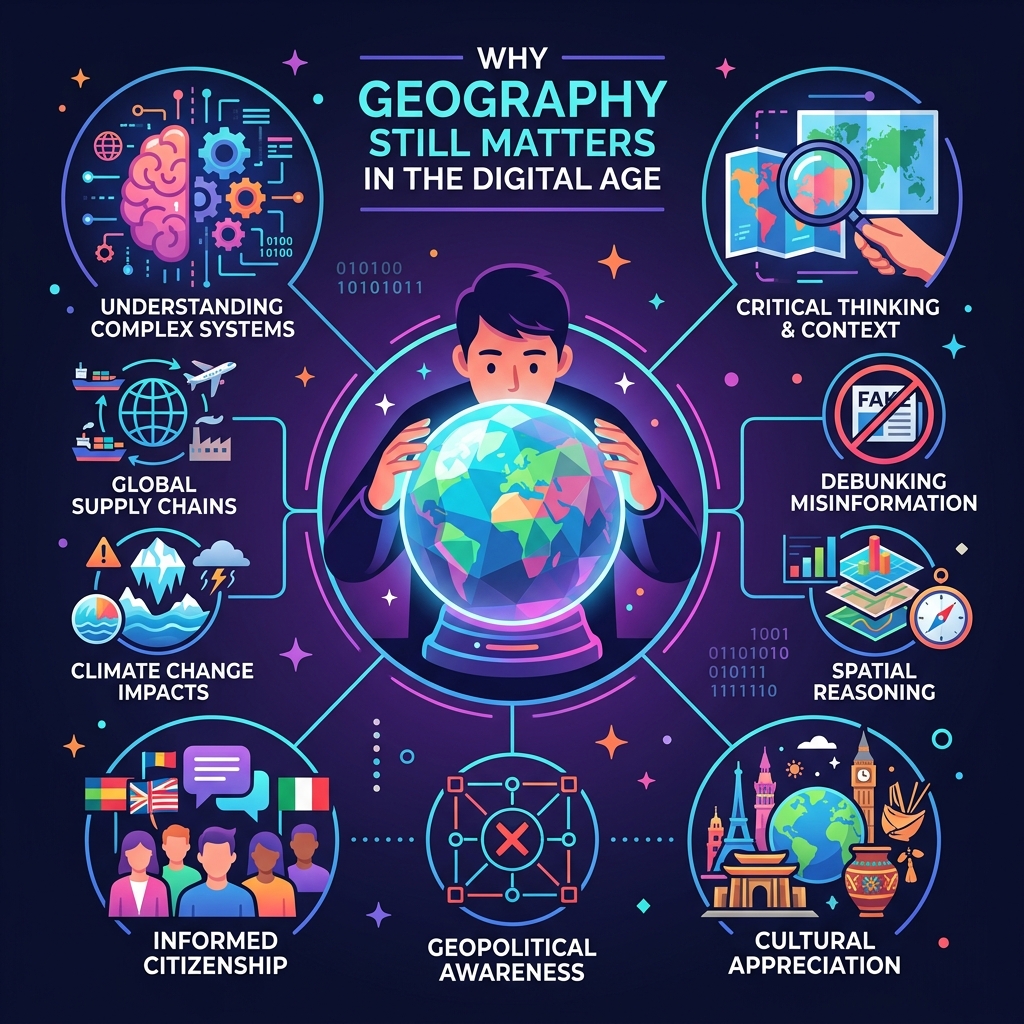
The "I can just Google it" argument fundamentally misunderstands how human intelligence works. The brain requires a foundational scaffold of knowledge to contextualize new information.
If you don't know roughly where a country is, you won't understand its climate, its likely economic partners, or its historical struggles. Searching for "Where is Sudan?" tells you its coordinates. Knowing beforehand that it borders Egypt, the Red Sea, and South Sudan allows you to instantly contextualize a news report about Nile water disputes or refugee crises. A search engine gives you isolated facts; a trained mental map gives you instant context.
Cultural Empathy and Global Citizenship
A lack of geographic knowledge breeds isolationism. When large swaths of the world are just blank spaces in our minds, it is easy to dismiss the people who live there. Knowing the shape, location, and neighbors of a country grants it a level of reality and respect.
In a globalized economy where a pandemic originating in one hemisphere can shut down the other in weeks, and where supply chains stretch across oceans, understanding the physical reality of our interconnectedness is not a luxury—it is a requirement for responsible global citizenship.
Spatial Reasoning is a Transferable Skill
As we've discussed in other articles, studying maps isn't just about memorizing names. It trains the brain's spatial reasoning capabilities. Identifying patterns in terrain, understanding scale, and navigating coordinate systems are cognitive exercises that translate directly into skills needed in STEM fields, from architecture to data science.
Making Geography Engaging
The problem is not that geography is obsolete; the problem is that traditional geography education—staring at static textbooks and memorizing lists—is boring. The digital age hasn't made geography irrelevant, but it has provided us with vastly superior tools to teach it.
Interactive, gamified experiences like Globdrop transform learning from a passive chore into an active, competitive challenge. When players are forced to actively triangulate the location of a city under a time limit, they build synaptic connections much faster than by reading a list of capitals.
Conclusion
Your smartphone can tell you where you are standing, but it cannot tell you how the world works. Geography is the foundational layer of human knowledge—it is where history, economics, politics, and culture physically occur. In an increasingly complex and interconnected world, a strong mental map is not a party trick; it is an essential lens for interpreting reality.