The Psychology of Getting Lost: Why Some People Have No Direction
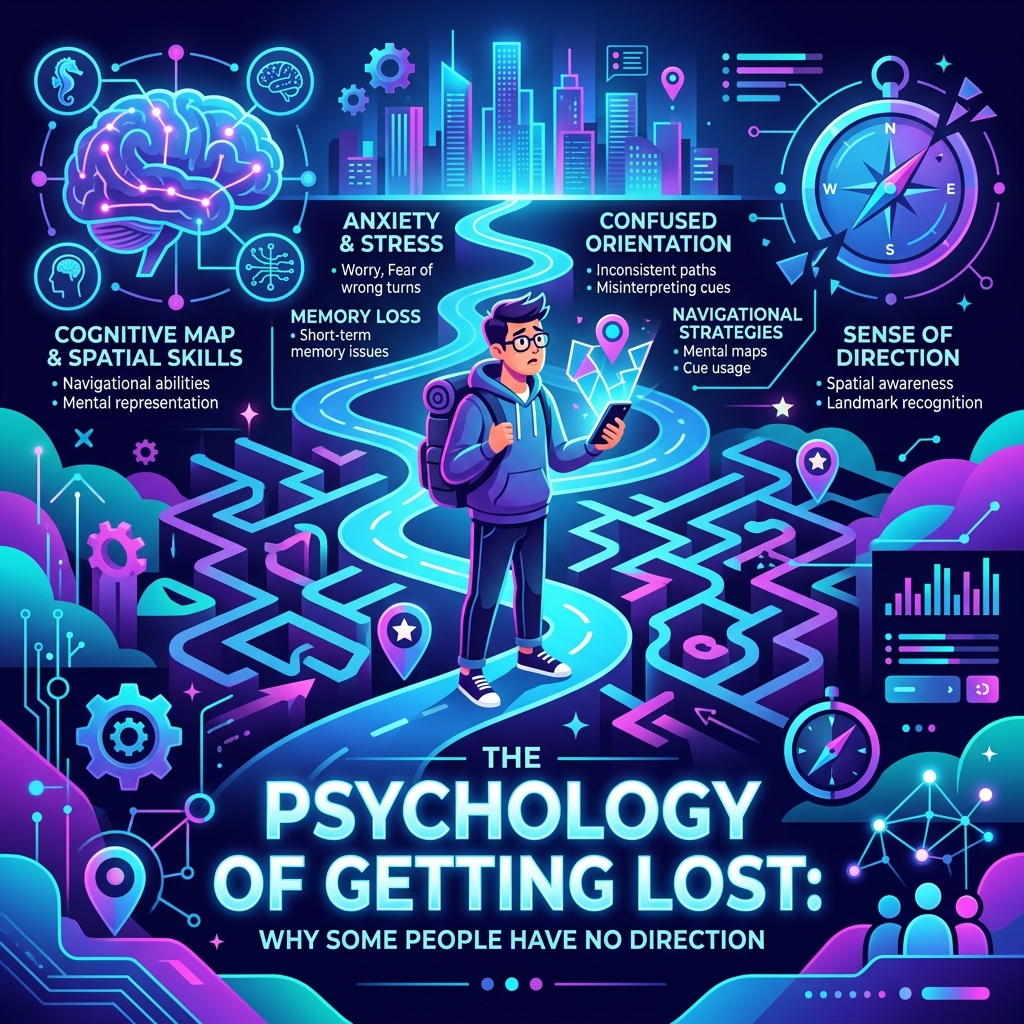
We all know someone who can't find their way out of a paper bag. They exit a store they just walked into and turn the wrong way down the street. They require a GPS to navigate to a friend's house they have visited five times. On the flip side, we know people who seem to possess an internal compass, navigating foreign cities intuitively after just one day. Why is there such a massive discrepancy in human navigational ability?
For a long time, having a "bad sense of direction" was written off as a quirky personality trait. However, modern psychology and neuroscience have revealed that getting lost is a complex phenomenon tied to brain structure, attention strategies, and even emotional regulation.
The Egocentric vs. Allocentric Navigator
Cognitive psychologists have identified two primary strategies humans use to navigate the world. Most people favor one, and your preferred strategy heavily dictates how often you get lost.
1. Egocentric Navigation (The Route Follower)
Egocentric navigators understand the world purely in relation to their own body. Their mental maps are essentially lists of instructions: "Go straight until the red building, turn left, go two blocks, turn right." If you drop an egocentric navigator in the middle of their route, they are fine. But if a road is closed and they are forced to deviate, their mental list breaks, and they are instantly, hopelessly lost. They have no overall concept of where their destination is relative to their current position.
2. Allocentric Navigation (The Map Maker)
Allocentric navigators, on the other hand, build a bird's-eye view of the environment in their minds. They track locations relative to each other, not to themselves. An allocentric navigator knows that the coffee shop is north of the park and west of the river. If a road is closed, they don't panic; they mentally consult their internal map and simply calculate a new vector. People with a "good sense of direction" are almost exclusively allocentric navigators.
The Biology of Direction
This preference isn't just a habit; it's visible in brain scans. The hippocampus is the seat of allocentric mapping. Studies show that people who are excellent navigators have high grey matter density in their hippocampus and use it actively when giving directions.
Conversely, egocentric navigators rely more heavily on the caudate nucleus, a region of the brain associated with habit formation and procedural memory (like riding a bike). They are treating navigation as a habit, not a spatial problem.
Spatial Anxiety: A Vicious Cycle
There is also a significant emotional component to getting lost. Psychologists have identified a condition known as "Spatial Anxiety"—a specific fear and stress response associated with environmental navigation.
Spatial anxiety creates a vicious cycle. When someone with a poor sense of direction gets slightly turned around, their amygdala (the brain's fear center) triggers a stress response. High levels of cortisol flood the brain, which has been shown to actively inhibit the function of the hippocampus. In other words, the more anxious you get about being lost, the less your brain is physically capable of figuring out where you are. This panic forces the person to revert to rigid, egocentric route-following, which often makes the situation worse.
Can You Fix a Bad Sense of Direction?
Yes. The brain is neuroplastic, meaning it can reorganize itself and build new pathways throughout your life. If you want to stop getting lost, you need to force your brain to switch from egocentric habits to allocentric mapping.
- Look Up: Poor navigators spend too much time looking at the ground or their phones. To build a mental map, you need distant landmarks. Look at skyscrapers, mountains, or the sun to orient yourself globally.
- Force the Map View: Before going somewhere new, study a map. Do not look at the turn-by-turn directions. Look at the overall shape of the route. Where is your destination relative to the highway?
- Play Spatial Games: Engaging in low-stress spatial puzzles, like 3D video games or interactive mapping games like Globdrop, trains the hippocampus to build allocentric maps without the panic of being lost in reality.
- Embrace the Detour: When you have free time, intentionally take a different route home. Let yourself get slightly lost in a safe environment, and practice calmly re-orienting yourself using landmarks instead of GPS.
Conclusion
Having a bad sense of direction is not a permanent affliction; it is simply an over-reliance on the wrong navigational strategy. By consciously practicing spatial awareness and managing the anxiety of the unknown, anyone can build a stronger, more reliable internal compass.