Agile vs. Waterfall: Why Not Both? A Hybrid Approach
If you spend any time in the project management or software engineering communities, you will eventually stumble into the holy war: Agile vs. Waterfall.
The Agile zealots claim that Waterfall is a dinosaur—a rigid, bureaucratic relic of the 1970s that guarantees delayed, over-budget projects. The Waterfall defenders argue that Agile is just an excuse for chaotic development without documentation, where engineers refuse to commit to deadlines under the guise of "iterative flexibility."
The truth, as always, lies somewhere in the middle. The most successful modern teams are quietly abandoning the dogmatic extremes and embracing a hybrid approach: macroscopic Waterfall planning combined with microscopic Agile execution.
The Strengths and Fatal Flaws of the Extremes
Pure Waterfall
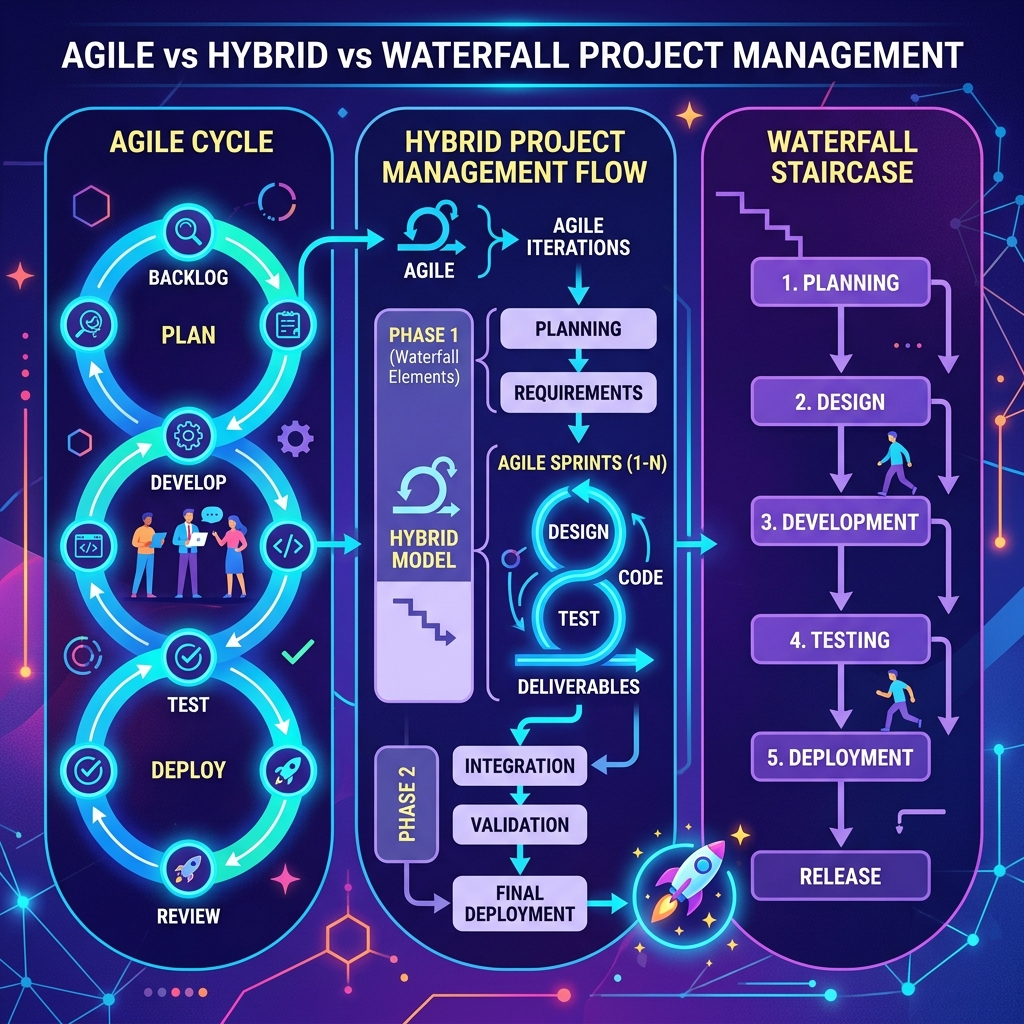
Waterfall relies on sequential phases: Requirements → Design → Implementation → Verification → Maintenance. You do not move to the next phase until the current one is 100% complete.
- The Strength: Extreme clarity. Before anyone starts working, the scope, budget, and timeline are fixed. Stakeholders know exactly what they are getting and when. It is highly predictable.
- The Fatal Flaw: Reality changes. If a client realizes during month 6 of a 12-month build that they need a different feature, the Waterfall structure fractures. Changing a foundational requirement late in a Waterfall project requires destroying and rebuilding months of work.
Pure Agile (Scrum/Kanban)
Agile breaks work into small, digestible chunks (sprints) usually lasting 1-4 weeks. Teams build, test, and release a small piece of functional product, gather feedback, and adjust their course for the next sprint.
- The Strength: Ultimate adaptability. Agile assumes requirements will change and embraces it. It delivers value early and continuously, ensuring the product actually fits the user's needs.
- The Fatal Flaw: The "When will it be done?" problem. Because Agile shuns long-term rigid roadmaps, it is notoriously bad at communicating with external stakeholders. If the CEO asks, "When will the massive platform migration be finished?", "We'll know more after the next three sprints" is not an acceptable business answer.
The Hybrid Solution: Water-Scrum-Fall
A hybrid methodology acknowledges a fundamental truth of business: engineering teams need flexibility to solve complex problems (Agile), but executive leadership, sales, and marketing need predictable timelines to run a profitable company (Waterfall).
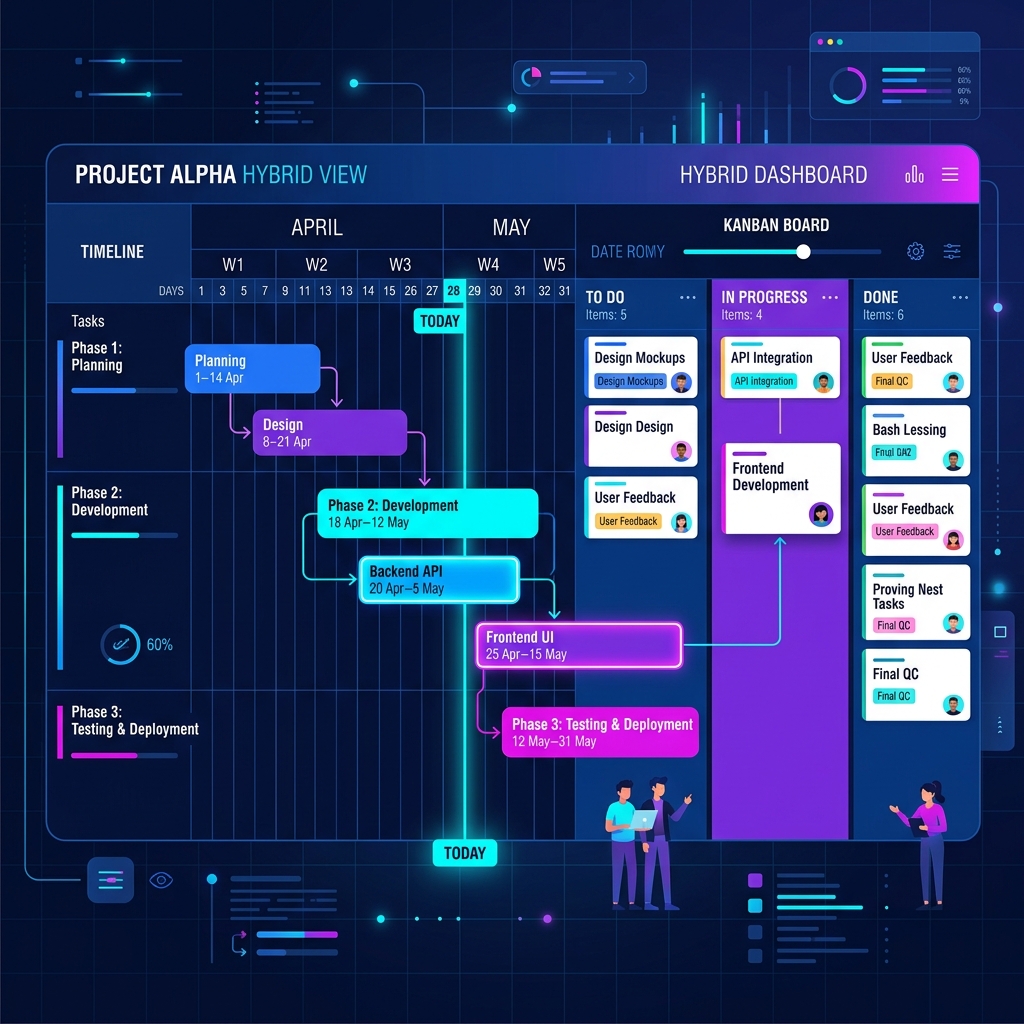
The solution is to use a visual timeline (like a Gantt chart) for the macro-level planning, and Agile boards (like Kanban) for the micro-level execution.
Phase 1: The Waterfall Wrapper (Planning & Strategy)
At the executive level, you plan using Waterfall logic. You define the high-level phases of the project, major milestones, and hard dependencies. You create a Gantt chart that shows the board of directors: "Phase 1: Infrastructure will take roughly 2 months. Phase 2: User Onboarding will take 3 months. Launch is targeted for October."
This satisfies the business need for budget forecasting, marketing coordination, and resource allocation. Marketing can confidently book ad space for October.
Phase 2: The Agile Engine (Execution)
Once "Phase 1: Infrastructure" begins, the engineering team does not write a massive Waterfall spec document. Instead, they take the two-month timebox and break it down into four 2-week Agile sprints.
Within those sprints, the team operates with pure Agile autonomy. They pull tickets, hold daily standups, and adjust their immediate priorities based on the technical challenges they discover in the code. The project manager doesn't micromanage the daily tickets; they only monitor whether the velocity of the sprints is sufficient to hit the overarching 2-month milestone.
Phase 3: The Waterfall Finish (Release & Compliance)
When the software is built, the project shifts back to Waterfall for final delivery. In many industries (healthcare, finance, aerospace), you cannot "fail fast and iterate" in production. You must undergo rigid security audits, legal compliance checks, and user acceptance testing before release. These are sequential, Waterfall-style checkpoints that ensure the product is legally and technically safe.
Why This Works
The hybrid approach resolves the cognitive dissonance of modern product development. It creates a boundary layer between the chaotic, creative reality of writing software and the structured, predictable reality of running a business.
Visual planning tools are the bridge between these two worlds. A high-level Gantt chart translates the chaos of 500 Agile Jira tickets into a clean, geometric roadmap that a CEO can digest in five seconds. Stop fighting over which methodology is morally superior, and start using the right tool for the right altitude of the project.